
The Divergence of European Equity Markets — One Currency, Very Different Returns
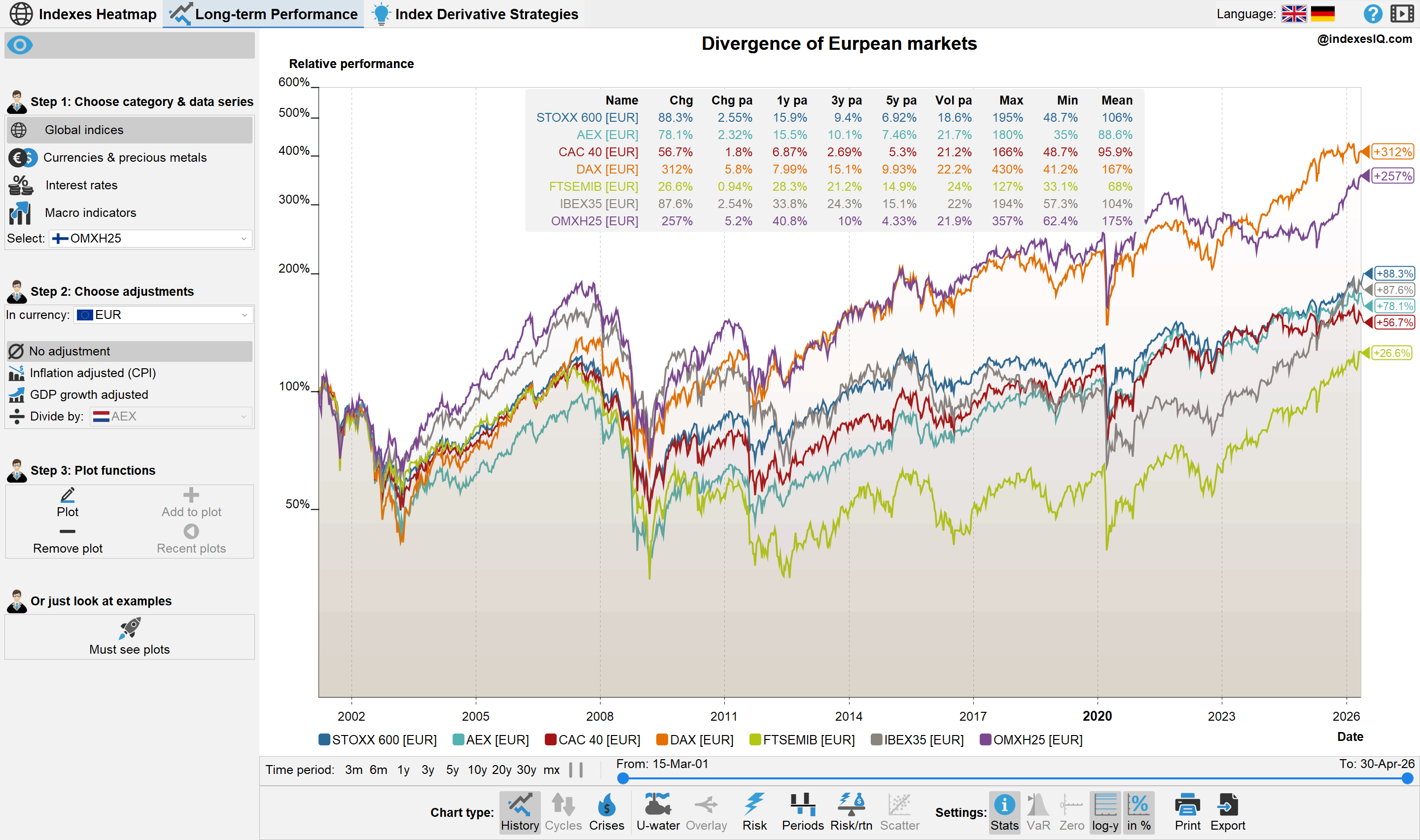
The eurozone was built on a promise of convergence — shared monetary policy, a single currency, integrated capital markets. Yet look at the long-term performance of its major equity markets since March 2001 and a strikingly different picture emerges. European equity markets have diverged dramatically, with the gap between the best and worst performers representing a multi-decade chasm in investor outcomes.
Over the study period from March 2001 to end of April 2026, Germany's DAX stands out as the clear winner among the indexes shown, while Italy's FTSE MIB (FTSEMIB) delivered the weakest long-term performance. The Netherlands' AEX, France's CAC 40, Spain's IBEX 35 and Finland's OMXH25 all fall somewhere in between, with the STOXX 600 — a broader pan-European benchmark that includes both eurozone and non-eurozone countries — providing a middle-ground reference.
However, before drawing conclusions about German corporate superiority, there is a crucial methodological point every investor must understand: the DAX is one of the very few major stock indexes in the world calculated as a total return index, meaning it automatically reinvests dividends. Most other major indexes — including the CAC 40, IBEX 35, FTSEMIB, AEX and OMXH25 shown here — are price-only indexes that exclude dividend income.
How much does this matter? The DAX has historically carried a dividend yield of around 2–3% per year. Over a 25-year period, compounded annually at 2.5%, dividends alone would add approximately 85% in cumulative return on top of the price return — a very substantial performance advantage that has nothing to do with the underlying strength of German companies. If the other indexes shown were also calculated on a total return basis, the gap between the DAX and its peers would narrow significantly. The DAX's apparent outperformance is partly real — but partly a measurement artefact.
Setting aside this methodological caveat, the divergence between Germany and Italy reflects real and deep structural differences. Germany's economy — anchored by world-class industrial exporters such as Siemens, BASF, SAP and Volkswagen — has benefited from global demand for capital goods and technology, even navigating the recent energy crisis and the structural decline of its automotive sector with relative resilience. Italy, by contrast, has faced decades of weak productivity growth, persistent political instability, a fragile banking sector and a sovereign debt burden that repeatedly spooked markets. The FTSEMIB's long-term underperformance is not a statistical anomaly — it reflects Italy's chronic inability to generate the kind of corporate earnings growth that drives equity returns.
A single currency does not mean a single equity market. Despite sharing the euro and integrated monetary policy, European equity markets have delivered radically different long-term returns driven by divergent economic structures, fiscal policies and corporate cultures. Investors face a genuine choice: concentrate in a specific country and accept country-specific risk, or diversify across the continent via a broad index like the STOXX 600 and accept an averaged outcome. The DAX's apparent leadership is also partly a methodological illusion — always check whether an index is calculated on a price or total return basis before comparing performance across markets.