
"The water was not fit to drink. To make it palatable, we had to add whisky. By diligent effort, I learnt to like it."
Winston Churchill
British Prime Minister, 1940–45 & 1951–55
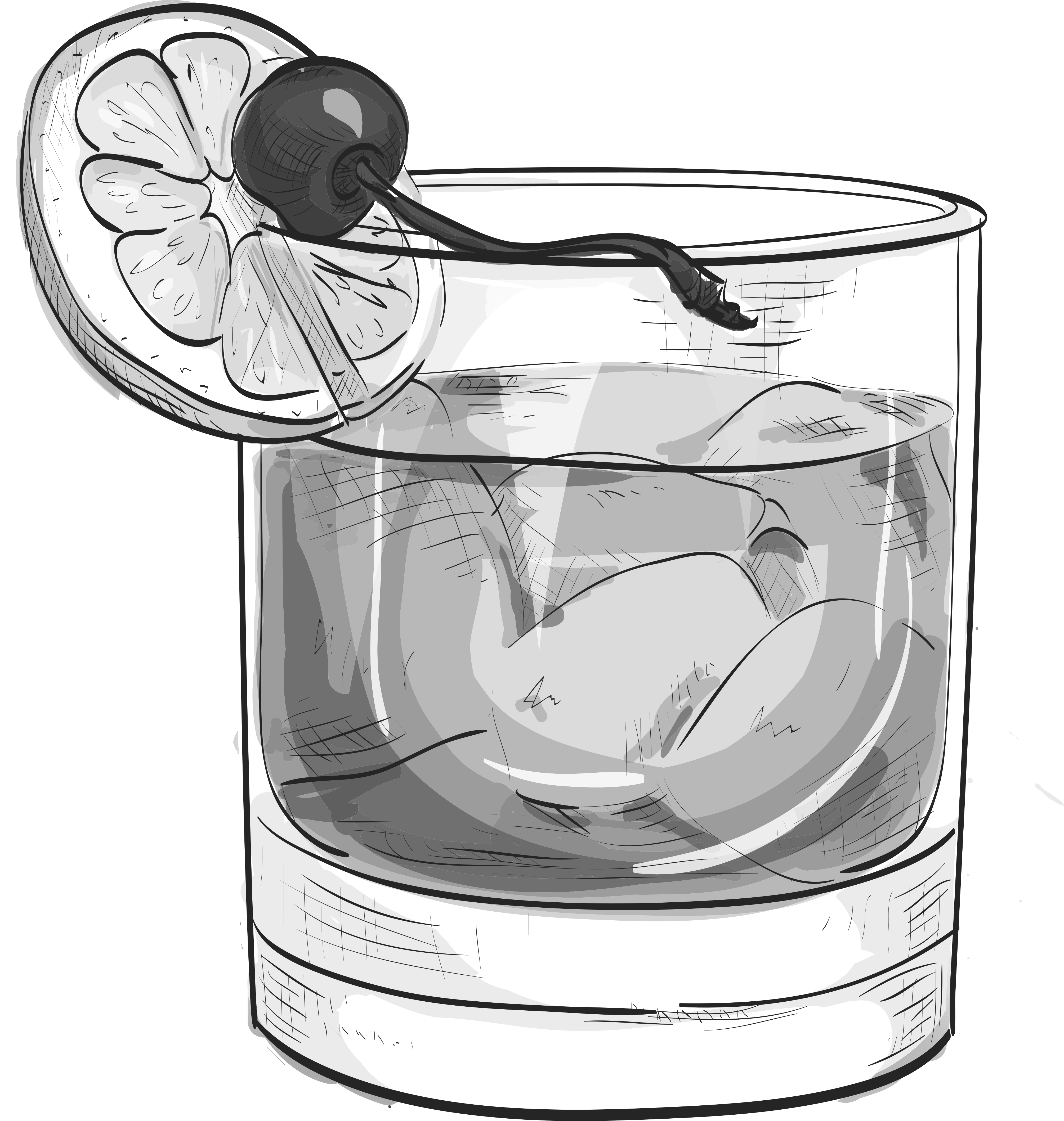
Perfect Old Fashioned
- 2 oz Scotch
- 1 dash Angostura bitters
- Splash of water
- 2 tbsp granulated sugar
- Garnish: orange slice & cherry
Risk exposure: 2 units of alcohol
Recipes for Yield Enhancement
The reverse convertible, discount certificate, barrier variants, worst-of products and express certificates — the old fashioned of structured products.
The old fashioned may have been invented in Louisville in the 1880s in honour of distiller James E. Pepper, before he brought it to the Waldorf-Astoria Hotel bar in New York. For most people, the old fashioned is the bar standard — short, strong, and to the point. It is a cocktail for testing times.
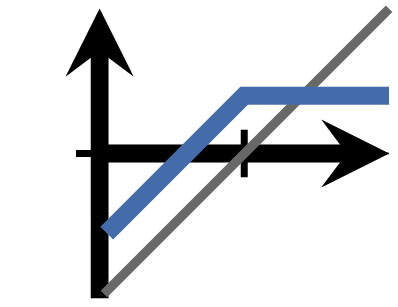
In the world of structured products, the reverse convertible is the old fashioned — and like the cocktail, it has driven a broad range of innovations in the yield enhancement category. Investors in yield enhancement products want to enhance the return on a "boring" coupon bond by selling options to increase the effective coupon. The reverse convertible perfectly illustrates the basic idea: invest in a bond and enhance the interest earned by selling a put option. In return, investors accept a concave payoff profile — above the put strike they receive a fixed coupon (higher than a standard bond), below the strike they bear the downside risk. The attractiveness of yield enhancement products is closely linked to prevailing interest rates and underlying equity volatility.
Payoff at issuance and maturity
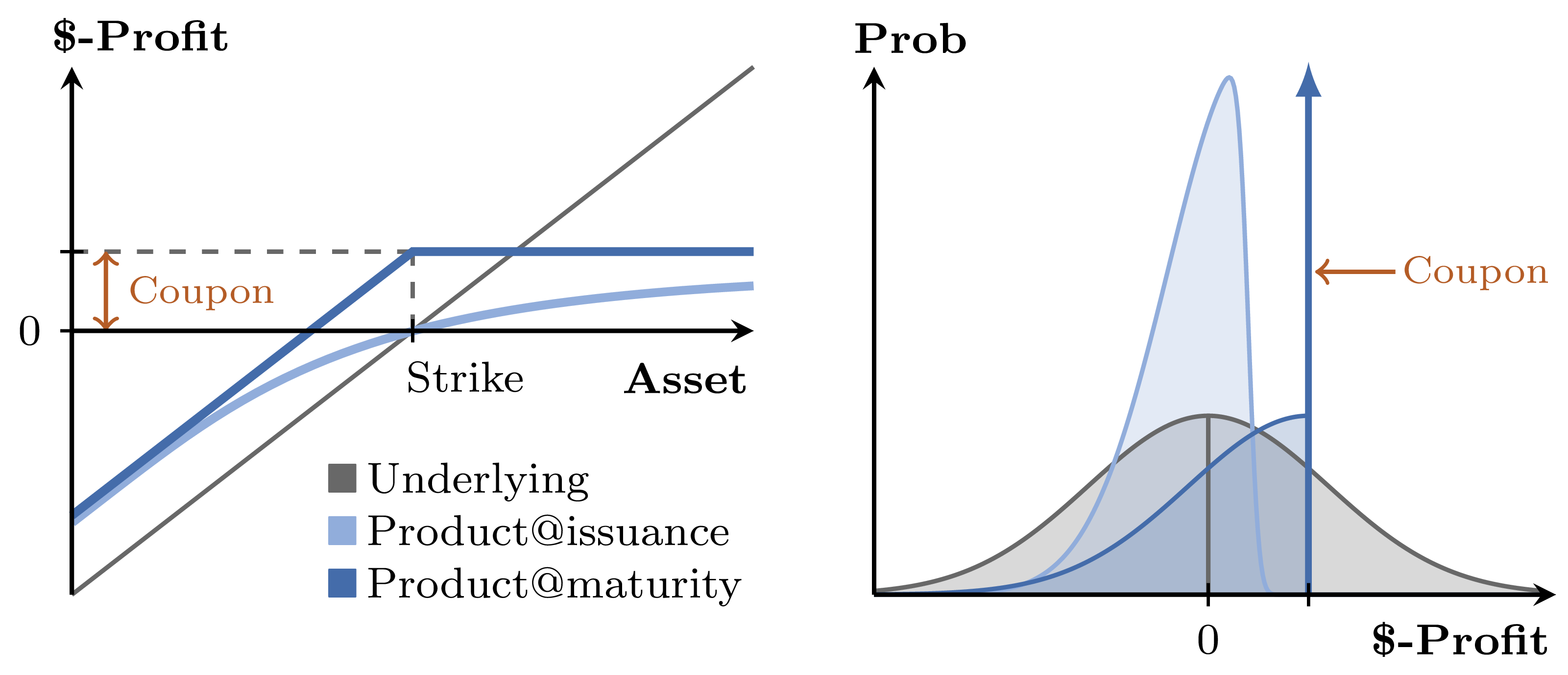
Product parameters
| Strike | At the money at issuance |
| Product Coupon | Paid at maturity |
Replicating portfolio
At issuance, invest the strike level plus the short put option premium into a coupon bond with face value at the strike.
 Reverse
Convertible
 Coupon
Bond
 Short Put
The bond coupon equals the Product Coupon and is chosen to ensure: Product value at issuance = Strike.
Risk matrix
| Return | During lifetime | At maturity |
|---|---|---|
| Outperformance | Rates↓, Vol↓ | Asset≈ |
| Forgone upside | Asset↑ above Coupon | |
| Loss | Rates↑, Vol↑ | Asset↓ |
The investor pays the same price for the reverse convertible as for the underlying asset. At maturity, when the asset goes sideways or down, investors are better off than direct asset holders — they receive the coupon regardless. If the asset rises more than the coupon, investors forgo the upside. The reverse convertible is the right tactical product when the asset price is expected to move sideways.
Many product issuers quote yield enhancement products as a percentage of the strike level (like a bond) rather than in currency values. A price of 98% means the product trades 2% below the strike. For context on government bond conventions, see the sovereign debt guide.
An equivalent way to build the reverse convertible uses a zero-bond instead of a coupon bond. Rather than reflecting the put premium in the bond's coupon, it is reflected in the zero-bond's face value:
Replicating portfolio
At issuance, invest the product capital plus the short put option premium into a zero-bond.
ReverseConvertible
Short PutAt issuance the amount invested in the zero-bond is chosen to ensure: Product value = Strike.
The discount certificate is closely related to the reverse convertible — the basic idea is to buy the underlying asset at a discount. The discount is obtained by forgoing upside in return for receiving the discount at issuance.
At first glance, the discount certificate looks identical to the alternative reverse convertible recipe: both use a zero-bond and a short put. But the devil is in the details. The reverse convertible invests a larger amount into the zero-bond (the full strike level plus option premium), while the discount certificate invests the strike level only — and grants the option premium as a discount at issuance. The result is that the discount certificate has a slight degree of leverage compared to the reverse convertible.
Payoff at issuance and maturity
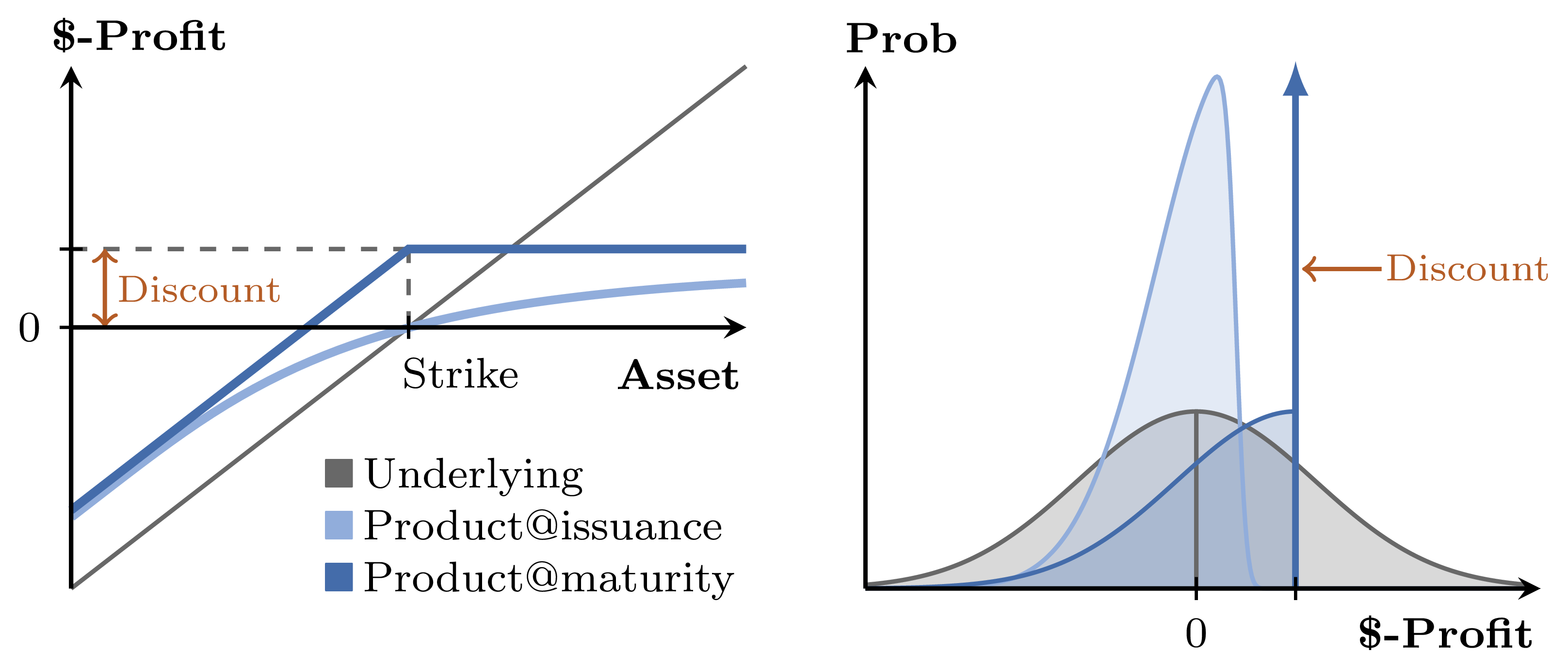
Product parameters
| Strike | At the money at issuance |
| Product Discount | Granted at issuance |
Replicating portfolio
At issuance, buy a zero-bond with face value at strike level and sell an at-the-money put on the asset.
DiscountCertificate
Short PutRisk matrix
| Return | During lifetime | At maturity |
|---|---|---|
| Outperformance | Rates↓, Vol↓ | Asset≈ |
| Forgone upside | Asset↑ | |
| Loss | Rates↑, Vol↑ | Asset↓ |
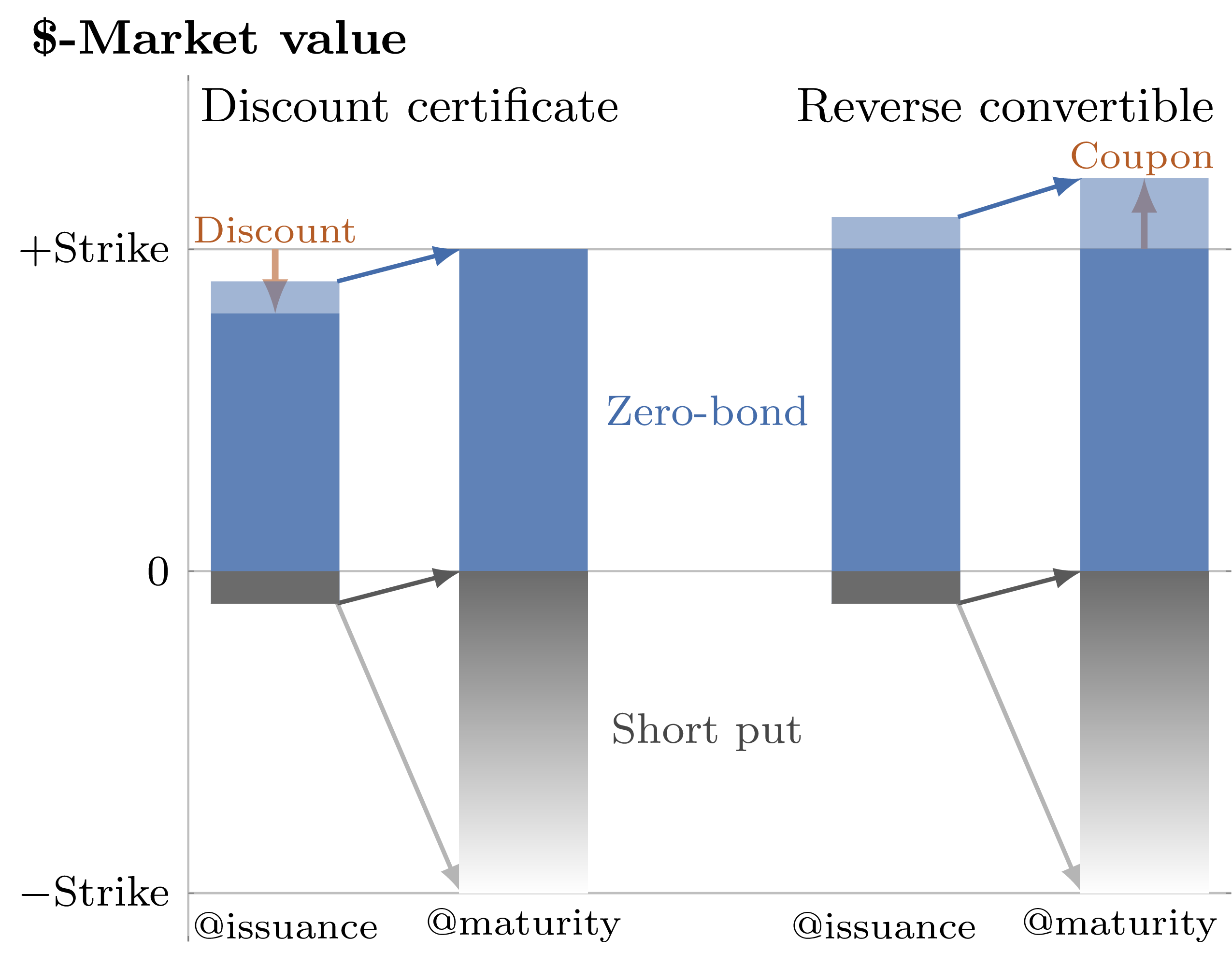
Cocktail mixtures of a discount certificate and reverse convertible. While the zero-bond's value grows continuously, the value of the short put option ranges between zero and minus the strike level at maturity.
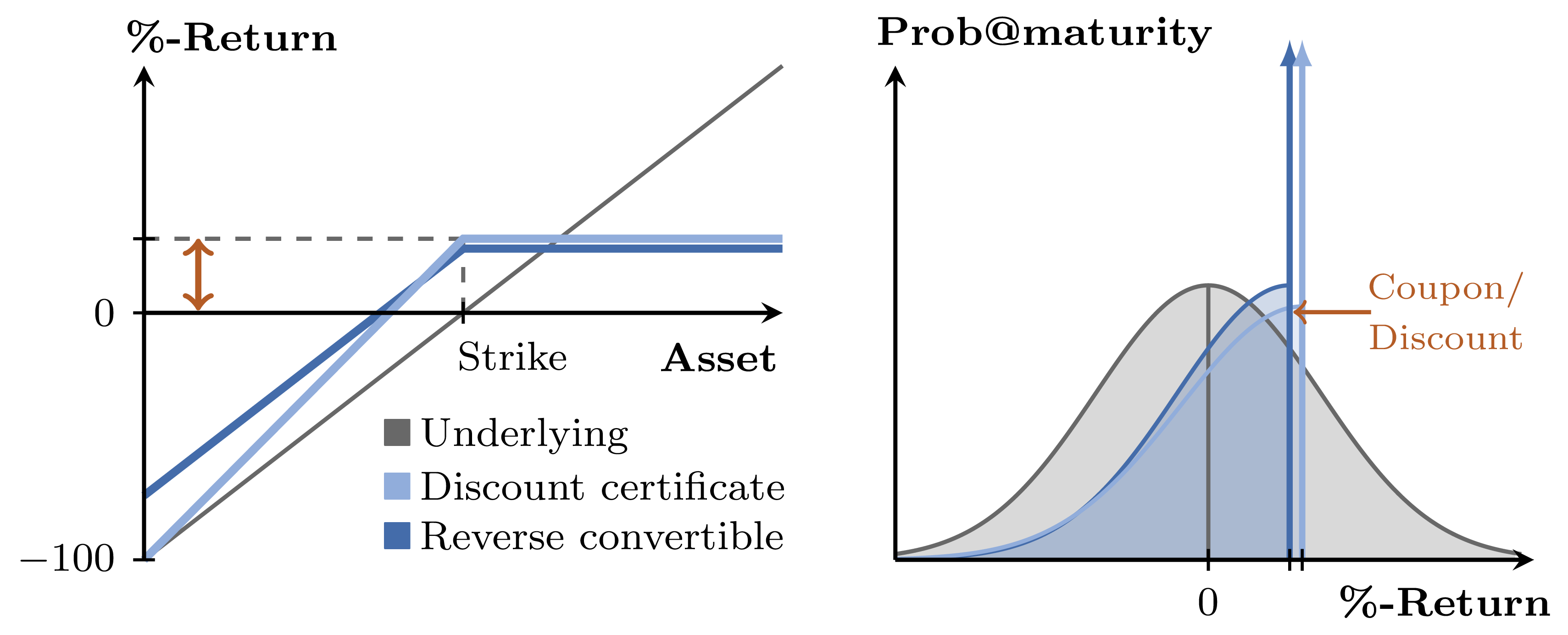
Left: %-Return at maturity. Right: return probability distribution. The slight degree of leverage of the discount certificate means its payoff can go to −100% and its return distribution is slightly broader.
There is also an alternative recipe for the discount certificate: invest in the underlying asset and sell an at-the-money call. The option premium received at issuance is the discount.
Replicating portfolio
At issuance, buy the asset at strike level and sell an at-the-money call option.
DiscountCertificate
 Asset
Asset Short Call
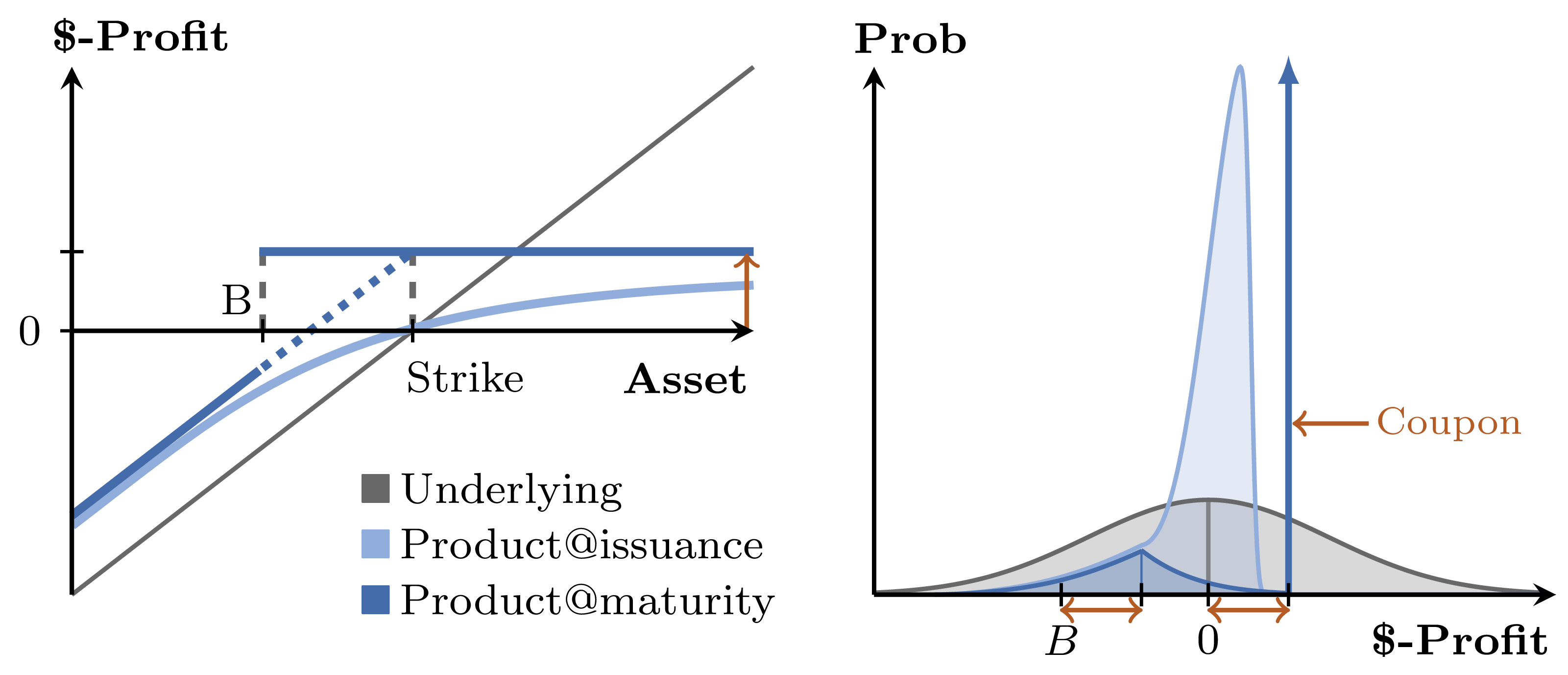
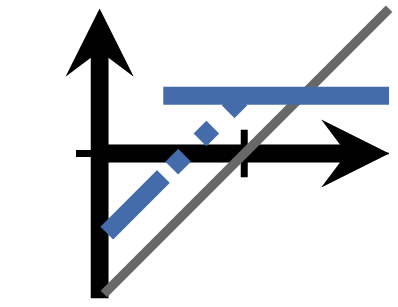
The reverse convertible exposes investors to significant downside risk if the asset falls below the strike. To reduce this risk, the barrier reverse convertible substitutes the short put with a short down-and-in put option — the put only comes into existence if the asset price falls below the barrier during the product's lifetime. The lower the barrier, the better the downside protection — but the lower the coupon, since the barrier put is cheaper than a standard put.
Payoff at issuance and maturity
Product parameters
| Strike | At the money at issuance |
| Barrier | Below the strike |
| Product Coupon | Paid at maturity |
Replicating portfolio
At issuance, invest the strike level plus the short down-and-in put premium into a coupon bond.
 Barrier Reverse
Convertible
CouponBond
 Short
ShortDown-and-in Put
The bond coupon equals the Product Coupon and is chosen to ensure: Product value at issuance = Strike.
Risk matrix
| Return | During lifetime | At maturity |
|---|---|---|
| Outperformance | Rates↓, Vol↓ | Asset≈; or Asset↓ & no barrier hit |
| Forgone upside | Asset↑ above Coupon | |
| Loss | Rates↑, Vol↑ | Asset↓ & barrier hit |
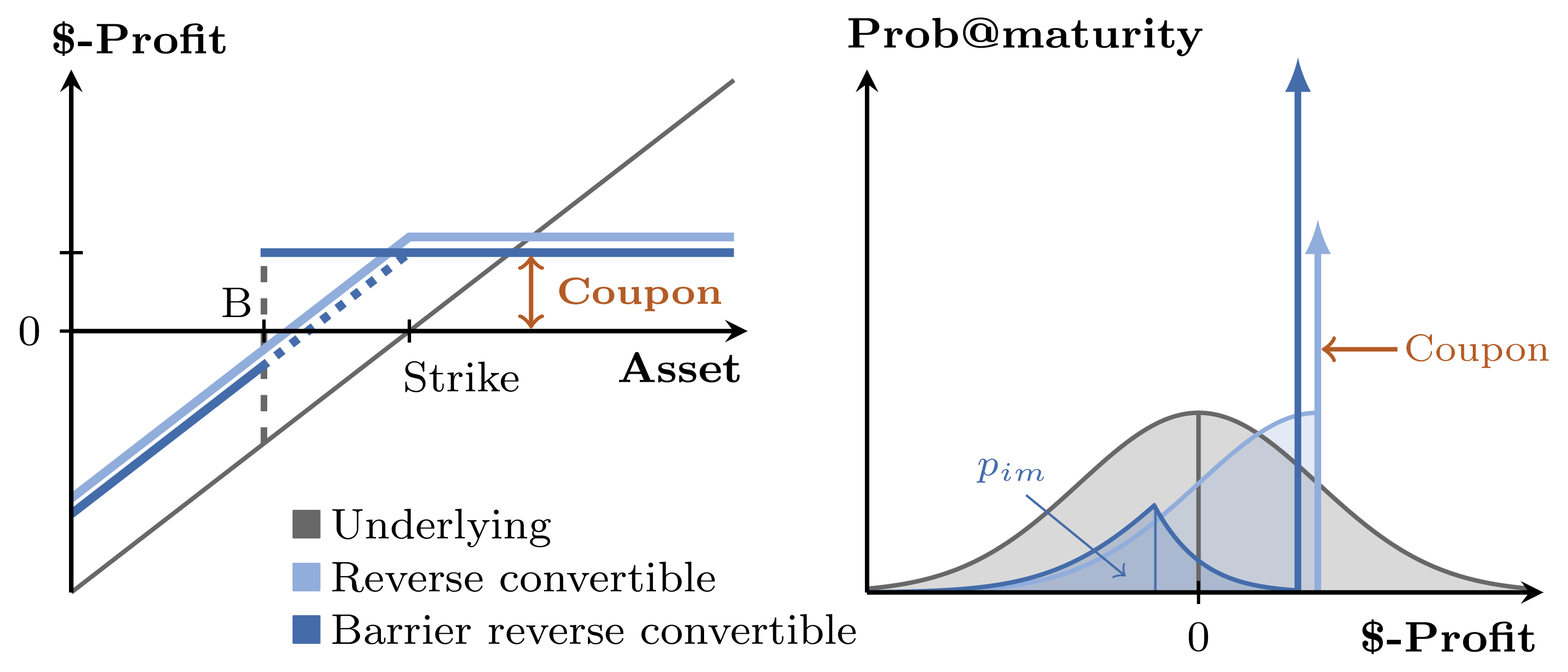
Left: Profit comparison (dotted line shows profit after a barrier hit). Right: probability distribution with the shaded area showing the option's in-the-money probability at maturity. The standard reverse convertible has a higher coupon but a lower probability of receiving it without any downside loss.
Can we achieve even higher coupons? The No Free Lunch Rule tells us: only by taking on more risk. One of the most common approaches is the worst-of barrier reverse convertible — identical in structure to the barrier reverse convertible, but based on a basket of underlying assets rather than one. The barrier put option always references the worst-performing asset in the basket since inception. This means the barrier is easier to hit — it only takes one asset to fall — and the coupon is correspondingly higher.
This introduces correlation risk. The less correlated the assets in the basket, the riskier the worst-of feature: with perfectly correlated assets, the basket behaves like a single asset and no additional risk is added. With uncorrelated assets, each additional asset in the basket adds an independent source of risk. The IndexesIQ stock market guide covers the major equity indexes commonly used as underlyings in worst-of baskets.
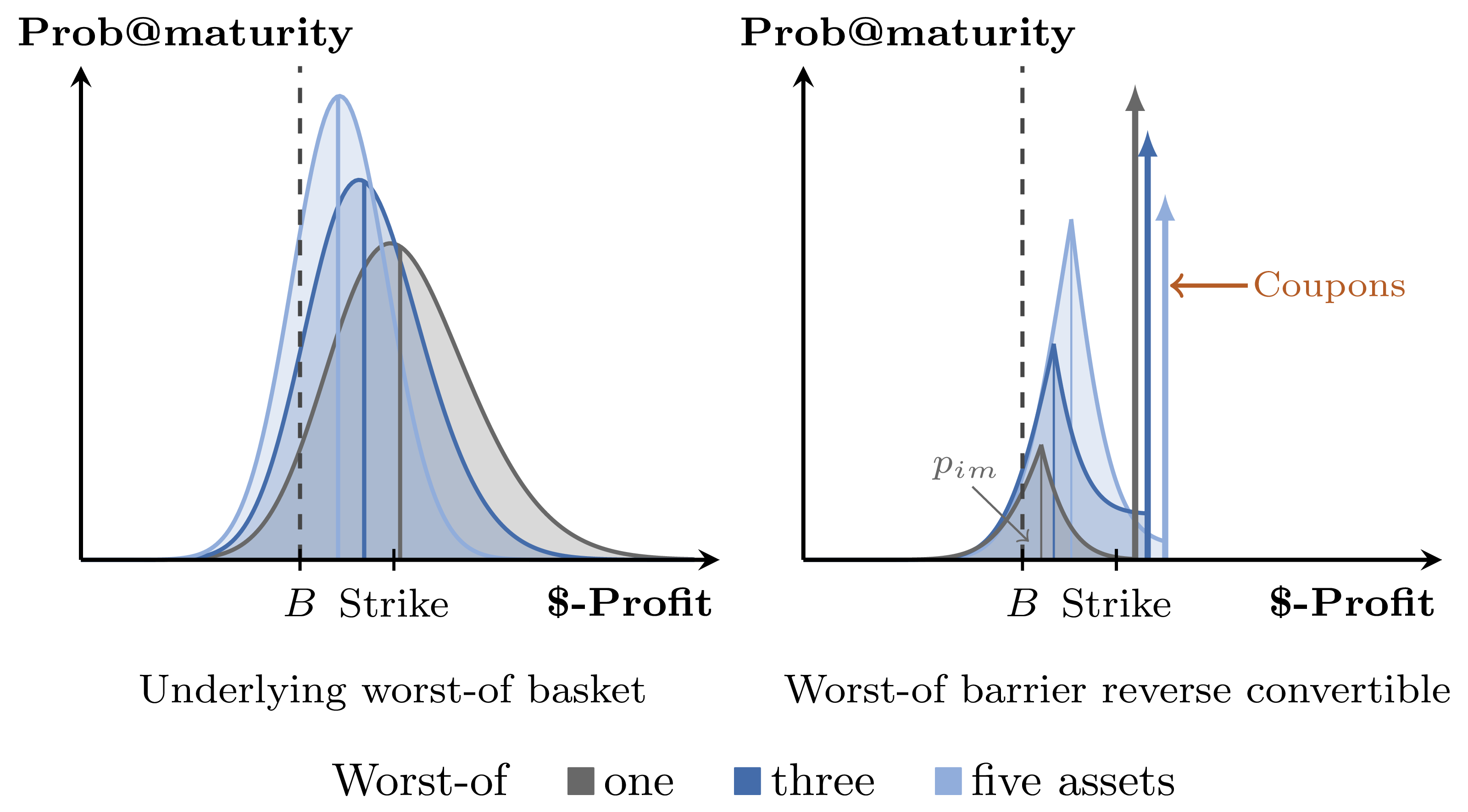
Left: probability distribution of the worst-performing asset for baskets of one, three and five uncorrelated assets. The distribution shifts left as more assets are added, increasing both barrier hit probability and loss severity. Right: simulated profit distribution for the worst-of barrier reverse convertible with a barrier at 70% of strike — higher risk means higher coupons but lower probability of receiving them without losses (lower spikes).
Risk matrix for worst-of barrier reverse convertible — includes an additional risk factor: correlation between underlying assets.
| Return | During lifetime | At maturity |
|---|---|---|
| Outperformance | Rates↓, Vol↓, Corr↑ | Asset≈; or Asset↓ & no barrier hit |
| Forgone upside | Asset↑ | |
| Loss | Rates↑, Vol↑, Corr↓ | Asset↓ & barrier hit |
An important distinction: in a severe market crash, assets are typically highly correlated and fall together — the worst-of feature adds relatively little extra risk in such scenarios. However, the worst-of feature always amplifies asset-specific risk (e.g. a single company's sharp drawdown). The more assets in the basket, the higher the idiosyncratic risk exposure.
The express certificate is one of the most popular innovations based on the reverse convertible concept. Unlike reverse convertibles, which always pay at maturity, the express certificate defines a set of observation dates during its lifetime. If the asset price is above a predefined level at an observation date, the product pays capital plus coupon early — hence "express." Later observation dates typically offer higher coupons. Express certificates come in versions with and without downside barriers.
Due to their complexity, most express certificates cannot be decomposed into basic ingredients. The exception is the easy express certificate — a simplified version with a single observation date at maturity. The SSPA Swiss Derivative Map lists express certificates under the yield enhancement category.
Payoff at issuance and maturity
Product parameters
| Strike | At the money at issuance |
| Barrier | Below the strike |
| Coupon | Paid at maturity only if asset price > strike |
Replicating portfolio
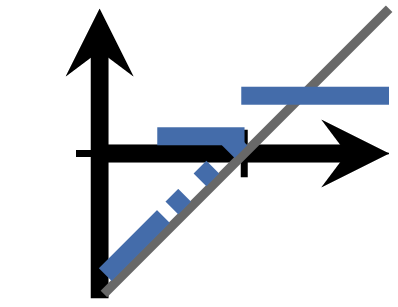
At issuance, invest the asset value plus the short down-and-in put premium into a zero-bond and a digital call.
 Easy
EasyExpress
ShortDown-and-in Put
 Coupon ×
Digital Call
The zero-bond's face value equals the Strike. The Coupon is chosen to ensure: Product value at issuance = Strike.
Risk matrix
| Return | During lifetime | At maturity |
|---|---|---|
| Outperformance | Rates↓, Vol↓ | Asset↑ below Coupon; or Asset↓ & no barrier hit |
| Forgone upside | Asset↑ above Coupon | |
| Loss | Rates↑, Vol↑ | Asset↓ & barrier hit |
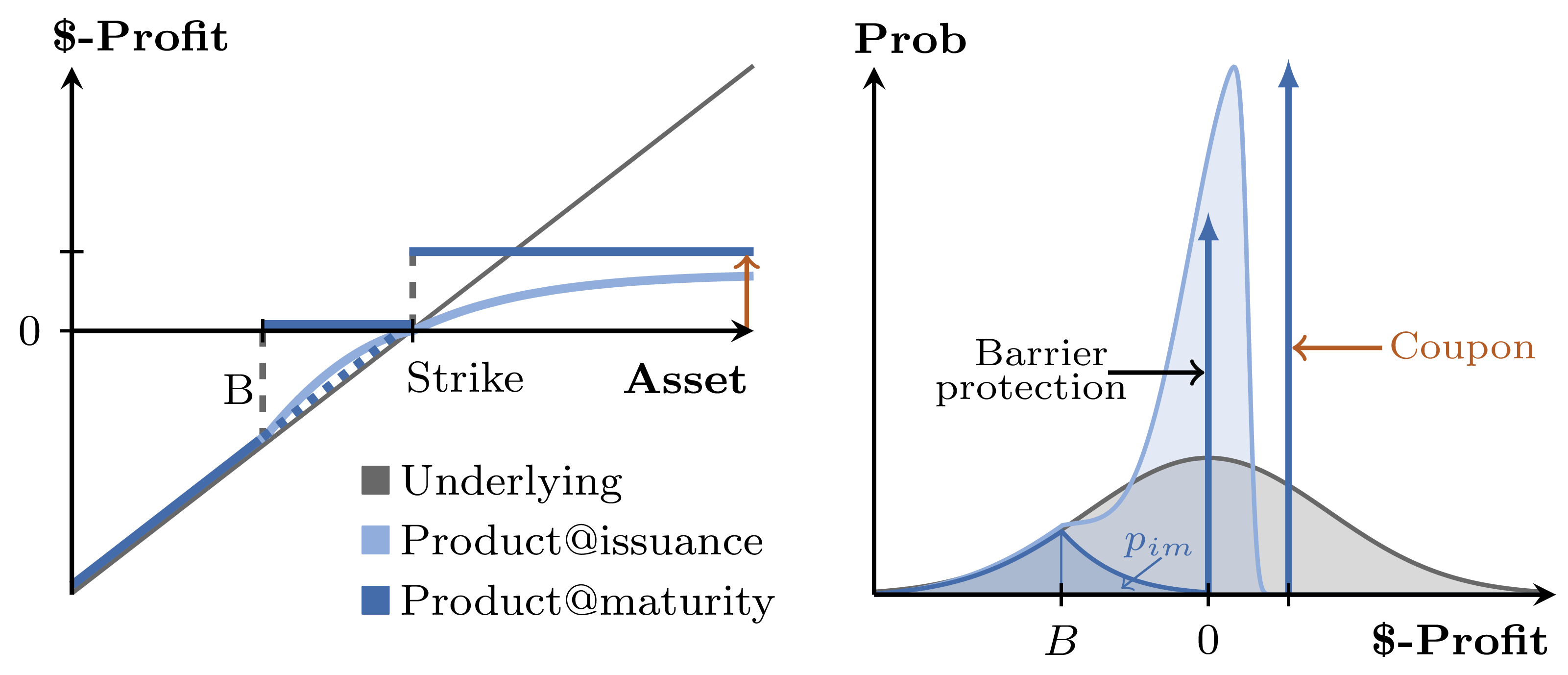
The probability distribution of the easy express certificate splits the single coupon spike of the barrier reverse convertible into two spikes: one for receiving the coupon (asset above strike at maturity) and one for not receiving it (asset did not touch the barrier but is below the strike).
Yield enhancement products sell options to enhance fixed-income coupons — investors accept a concave payoff in return for higher income
The coupon enhancement increases with the level of risk taken by selling options
The reverse convertible (coupon bond + short put) and discount certificate (zero-bond + short put) look similar but differ in investment amount and degree of leverage
Barrier variants reduce downside risk by substituting the short put with a short down-and-in put — lower barrier means less risk but also a lower coupon
The worst-of feature references the worst-performing asset in a basket — higher coupon but amplified barrier hit probability and correlation risk
Express certificates add the possibility of early redemption at observation dates — later dates offer higher coupons
If you cannot decide between a modern Vesper Martini and something more old-fashioned, the Churchill cocktail may be the solution — a shaken, citrus-flavoured whisky cocktail with good balance. Created for one of Churchill's many visits to the Savoy — the hotel where he received the phone call telling him he was to be prime minister of wartime Britain.
Churchill Cocktail
- 1½ oz Scotch
- ½ oz sweet vermouth
- ½ oz triple sec
- ½ oz lime juice
- Ice cubes
Risk exposure: 2.5 units of alcohol
"Politics is almost as exciting as war, and quite as dangerous. In war you can only be killed once, but in politics many times."
Winston Churchill
British Prime Minister, 1940–45 & 1951–55
For educational purposes only. Not investment advice. Derivative products carry significant risks and may not be suitable for all investors.