
"Shaken, not stirred."
Dr. No (1962)
First James Bond film — the villain said it first
Vesper Martini
- 3 oz London dry gin
- 1 oz vodka
- ½ oz dry vermouth
- Garnish: lemon peel
Risk exposure: 2 units of alcohol
Recipes for Capital Protection
How capital-protected certificates are constructed, the participation-protection trade-off, and three variants for different market views.
Did you know it was not James Bond who first used the famous expression "shaken, not stirred" in the movie series — it was his opponent Dr. No? It wasn't until Goldfinger that Bond actually started ordering his martini that way. In the book series, however, Bond used this expression from the very first novel, Casino Royale, and gave his favourite cocktail the name "Vesper."
James Bond's martini and the capital-protected certificate have something in common: there are two basic ways to create one — "shaking" or "stirring" in a metaphorical sense. The purpose of a capital-protected certificate is to invest in an asset while ensuring that, at maturity, the investor receives at least a protected minimum level of capital — even if the asset price has fallen. The SSPA Swiss Derivative Map classifies capital protection as the first of the four main structured product categories.
Shaking — Invest in a zero-bond (which pays the protected capital at maturity) and buy an at-the-money call option for upside exposure:
 Capital Protected
 Call Option
Stirring — Invest directly in the underlying asset and buy an at-the-money put option for downside protection:
Capital Protected Asset
Asset Put Option
Both recipes produce the exact same payoff due to call-put parity (explained in Chapter 3). Investors buying capital protection may not care whether it is shaken or stirred.
At issuance, the replicating portfolio invests $B_0$ into a zero-bond that pays the capital $A_0$ at maturity. With positive interest rates, $B_0 < A_0$ — the zero-bond is priced at a discount. The interest rate discount $A_0 - B_0$ is then invested into an at-the-money call option for upside participation. The total investment equals $A_0$, the same as buying the asset directly.
At maturity: the investor definitely receives $A_0$ from the zero-bond. If the asset rises, the call option pays additional upside. If the asset falls, investors receive their initial capital but the interest rate $A_0 - B_0$ is forgone — it was used to buy the option.
There is a catch. The interest rate discount $A_0 - B_0$ is typically much smaller than the cost of a call option $p_0^c$. So the upside participation is:
For every dollar the asset rises above $A_0$ at maturity, investors receive less than one dollar of upside. To achieve higher participation, the product provider must "dilute" the protection level — putting some initial capital at risk to buy more upside. The fundamental trade-off relationship is:
where $b_0 = B_0/A_0$ is the zero-bond's percentage price at issuance. The lower the protection level, the higher the achievable participation — this is the No Free Lunch Rule in action.
The trade-off improves with higher interest rates (lower bond price, more capital available for the option) and worsens with higher asset price volatility (more expensive options). This is why central bank policy rate decisions directly affect how attractive capital protection products are — in periods of very low interest rates, protection levels at or close to 100% with meaningful upside participation are essentially impossible. See government bond markets for context on how zero-bond pricing relates to sovereign yields.
For equity products, dividends can help: if the structured product is launched on a price index (excluding dividends), the dividends earned can be added to the interest rate to finance additional option exposure — making the participation-protection trade-off more attractive.
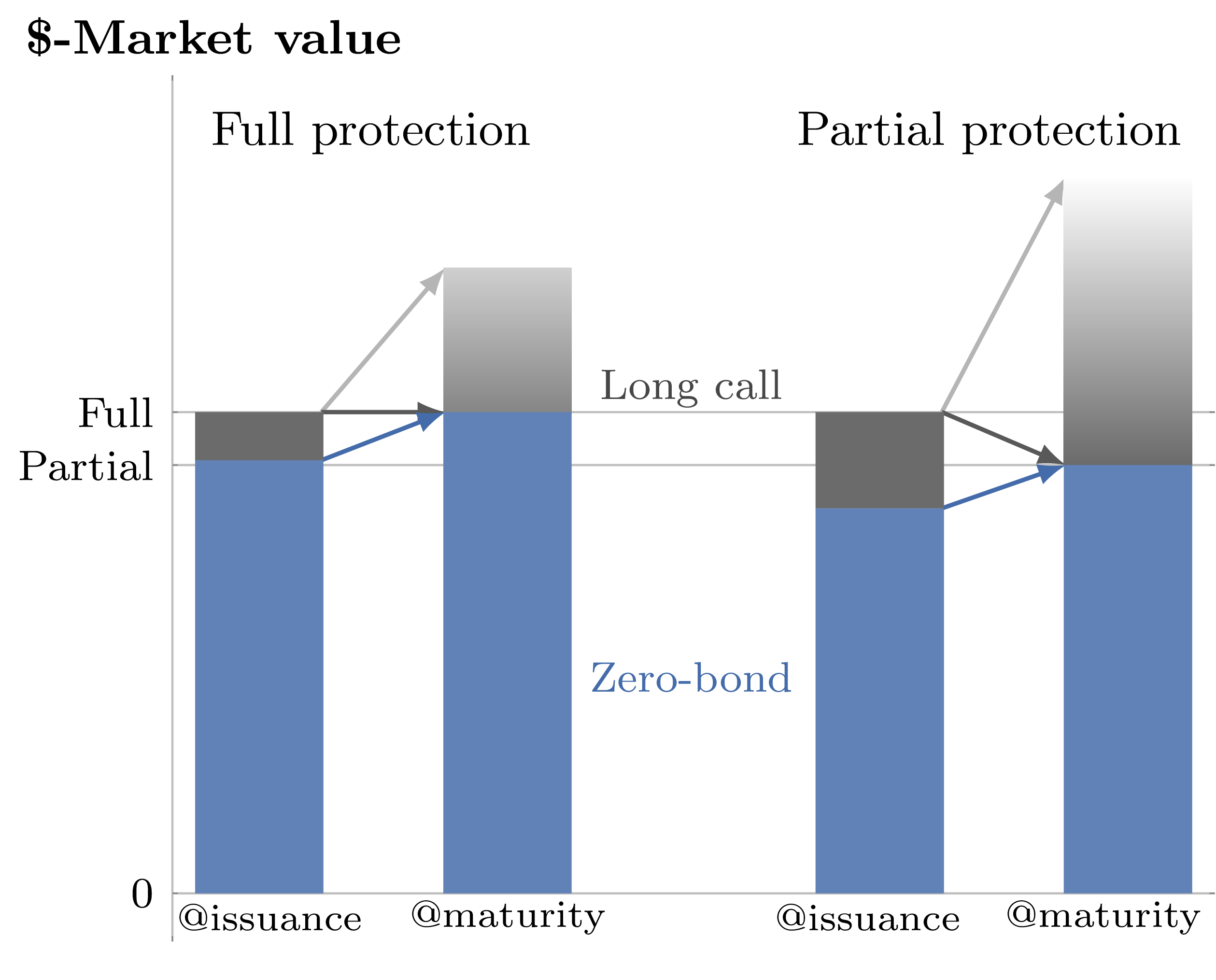
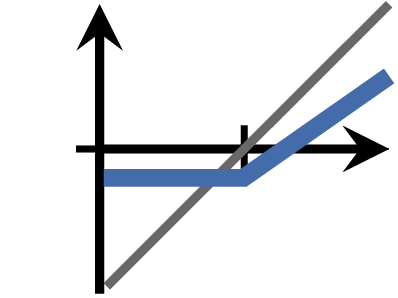
Capital protection certificate with full protection (left) and partial protection (right) at issuance and maturity. Horizontal lines indicate the respective protection level. Partial protection allows for higher upside participation by putting a portion of the initial capital at risk.
Payoff at issuance and maturity
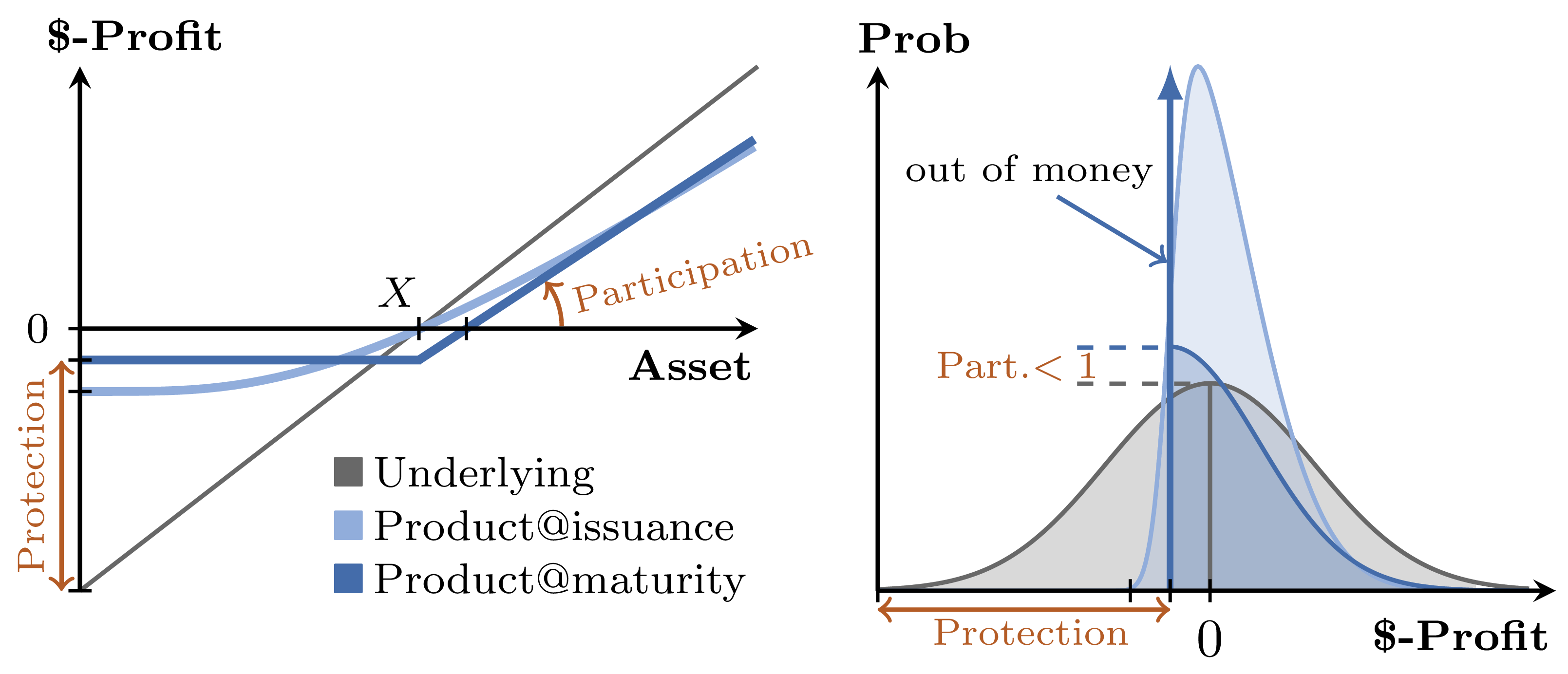
Product parameters
| Strike X | At the money at issuance |
| Participation (≤1) | Upside participation above the strike |
| Protection (≤1) | Downside protection below the strike |
Replicating portfolio
At issuance, buy Protection × (zero-bond with face value at strike) and Participation × (at-the-money call).
 Capital
Protected
Zero-Bond
Participation ×Long Call
Participation and Protection are chosen to ensure: Product value = Strike at issuance.
Risk matrix
| Return | During lifetime | At maturity |
|---|---|---|
| Outperformance | Rates↓, Vol↑ | Asset↓ |
| Forgone upside | Asset↑ & Participation < 1 | |
| Loss | Rates↑, Vol↓ | Asset↓ & Protection < 1 |
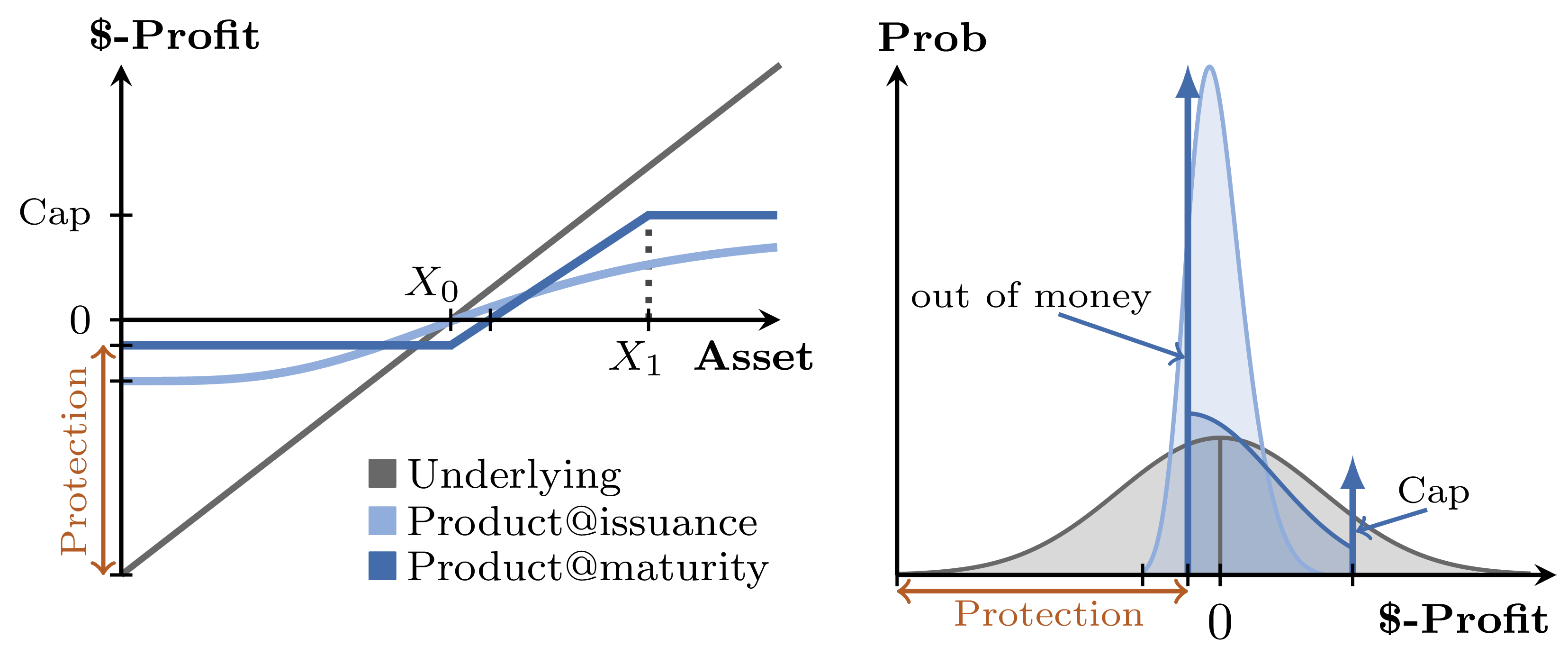
The probability distribution has a characteristic spike at the protection level at maturity — the discrete probability that the call expires out of the money. The protection level is only guaranteed at maturity: before that, the product's value can fall below the protection level as the time value of the call and bond value change.
Using call-put parity, an equivalent recipe invests directly in the underlying asset and adds a put option for protection. Both approaches produce the identical payoff:
Replicating portfolio
At issuance, invest Participation × the underlying asset and Protection × at-the-money put.
CapitalProtected
Participation ×Asset
Protection ×Long Put
Participation and Protection are chosen to ensure: Product value = Strike at issuance.
What if investors believe the underlying asset has limited upside potential during the investment period? They can explicitly cap the upside at a predefined cap level above the current asset price. The No Free Lunch Rule tells us they must be compensated — and indeed, giving up the upside above the cap allows for an improved participation-protection trade-off below it.
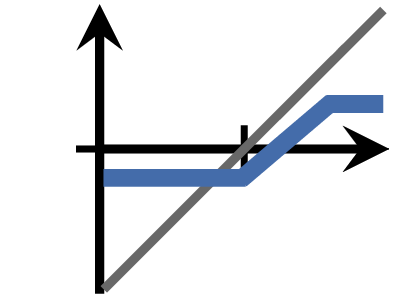
Technically, the cap is implemented by selling a call at the cap level. The premium received finances improved parameters below the cap. The payoff is squeezed between the protection level and the cap, producing two probability spikes at maturity: one at the protection level (asset falls) and one at the cap (asset rises sharply).
Payoff at issuance and maturity
Product parameters
| Strike X₀ | At the money at issuance |
| Strike X₁ | Defines the upper cap level (X₁ > X₀) |
| Participation (≤1) | Participation between X₀ and X₁ |
| Protection (≤1) | Downside protection below X₀ |
Replicating portfolio
At issuance, buy Protection × zero-bond (face value X₀), buy Participation × Call (strike X₀) and sell Participation × Call (strike X₁).
 Capped
Capital Prot.
Zero-Bond
Participation ×Long Call X₀
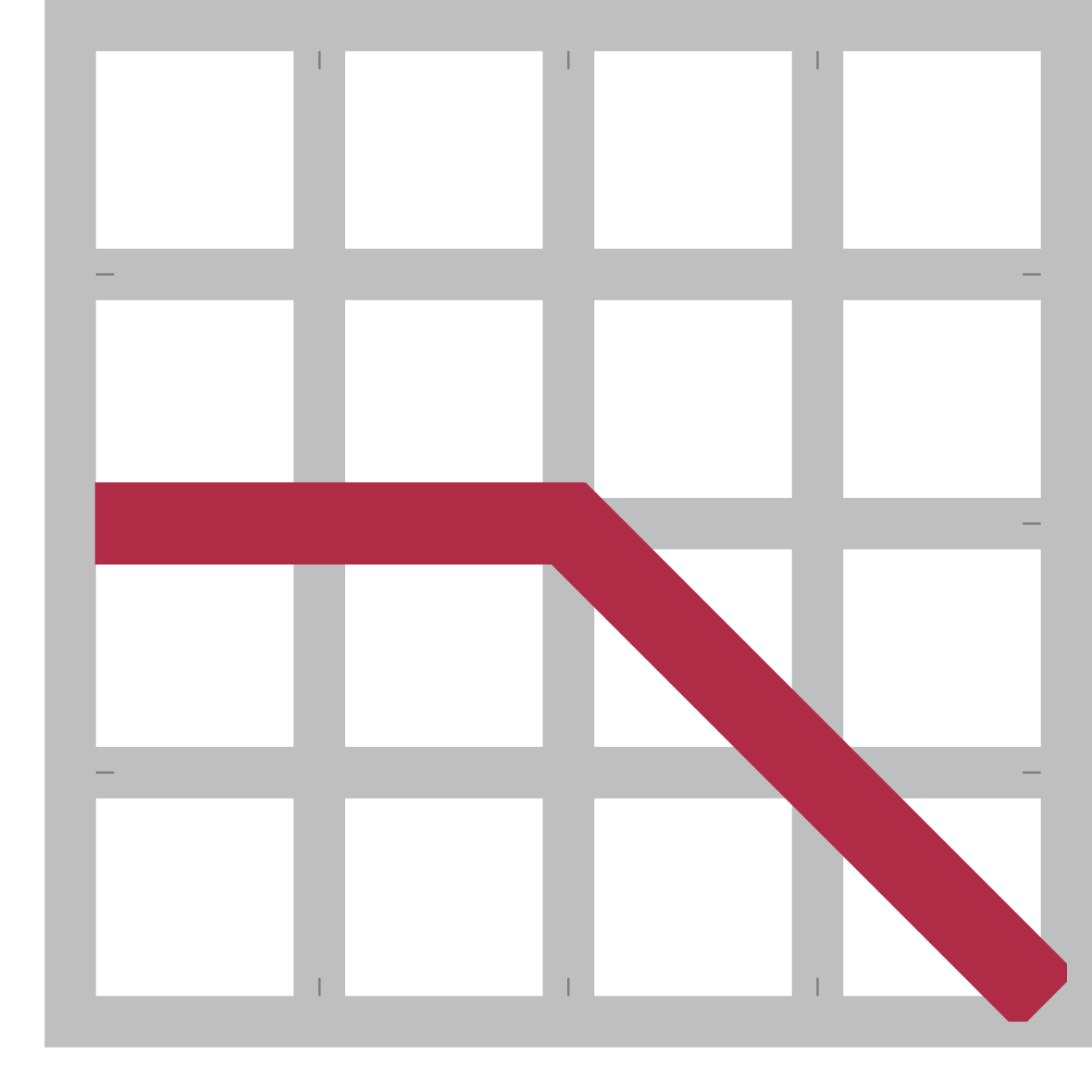 Participation ×
Short Call X₁
Risk matrix
| Return | During lifetime | At maturity |
|---|---|---|
| Outperformance | Rates↓, Vol↑ | Asset↓ |
| Forgone upside | Asset↑ above X₁ | |
| Loss | Rates↑, Vol↓ | Asset↓ & Protection < 1 |
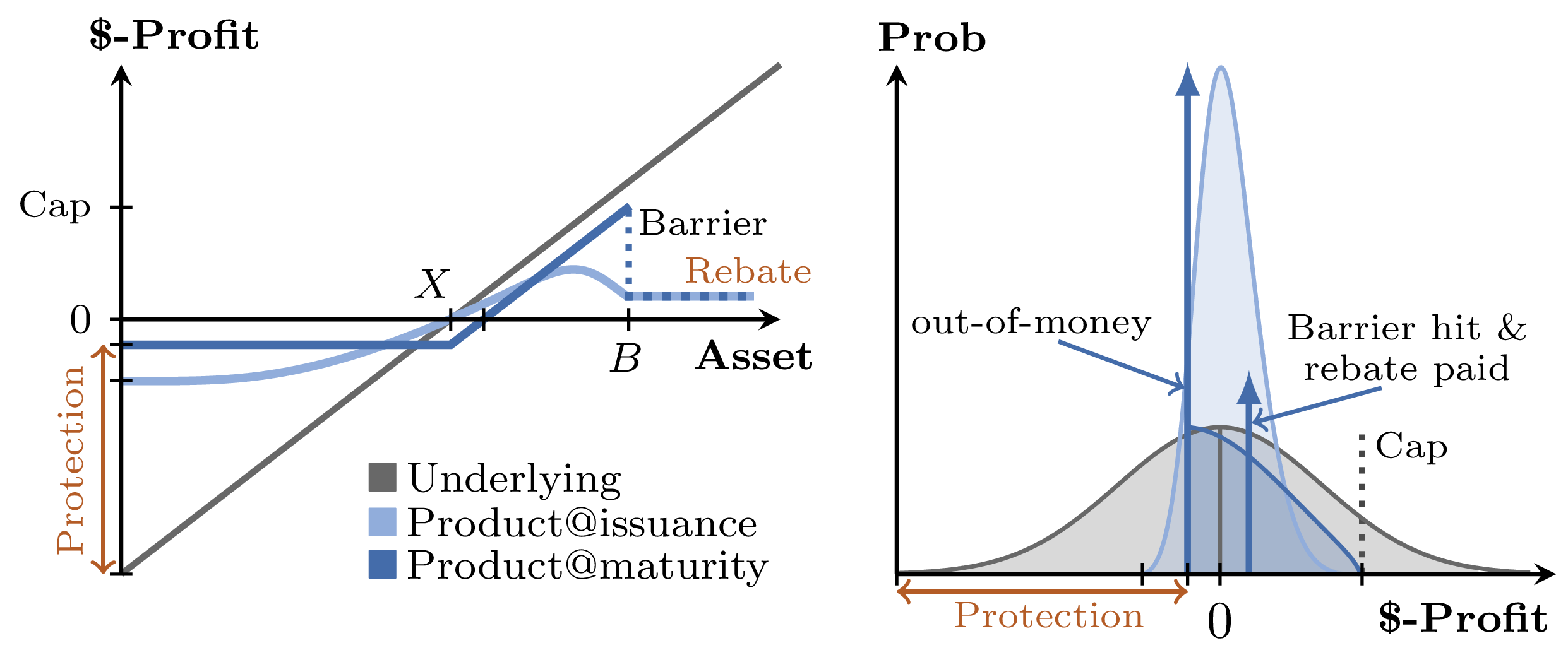
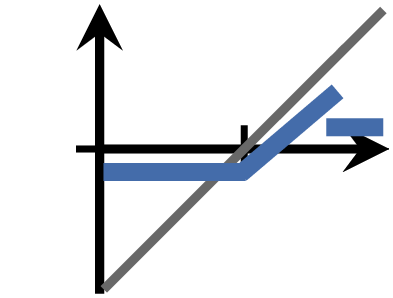
Can we achieve 100% upside participation and high capital protection? The No Free Lunch Rule says no — but we can change the trade-off. The barrier capital-protected certificate offers 100% participation up to a barrier level, but investors forfeit all upside if the asset price touches the barrier. This suits investors who expect benign upside — but are willing to lose it all if the asset rises sharply beyond the barrier.
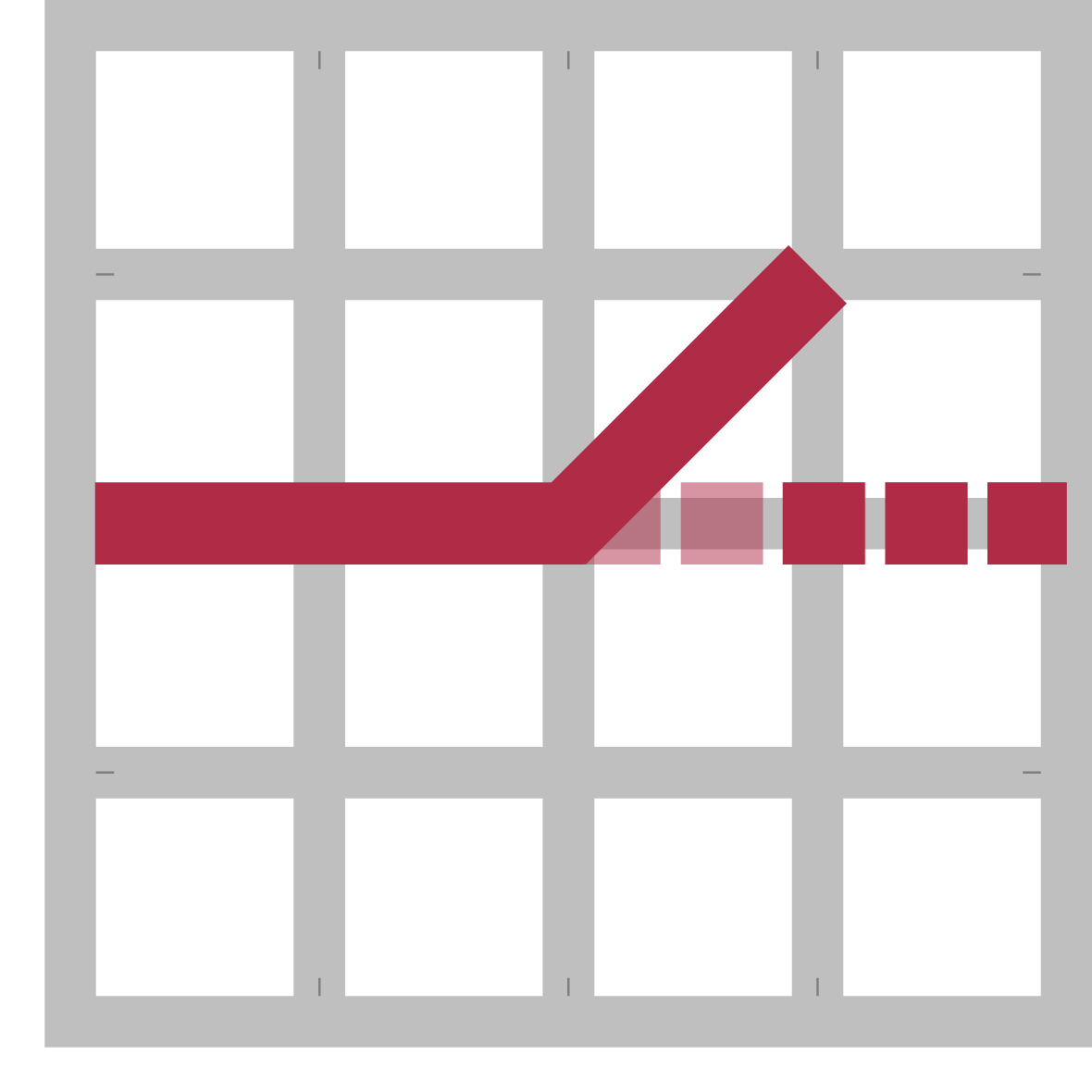
The standard call option is replaced with an up-and-out call option (optionally with a rebate). The participation-protection trade-off becomes: high protection ⟺ high barrier and high rebate.
Payoff at issuance and maturity
Product parameters
| Strike X | At the money at issuance |
| Barrier B | Upside capped (B > X) |
| Rebate | Dollar rebate paid at maturity if the barrier is hit |
| Protection (≤1) | Downside protection below X |
Replicating portfolio
At issuance, invest Protection × (zero-bond with face value at strike) and one up-and-out call option.
 Barrier
Capital Prot.
Zero-Bond
 Up-and-out
Call
Barrier and Rebate levels are chosen to ensure: Product value = Strike at issuance.
Risk matrix
| Return | During lifetime | At maturity |
|---|---|---|
| Outperformance | Rates↓, Vol↑ | Asset↓ & no barrier hit |
| Forgone upside | Asset↑ & barrier hit | |
| Loss | Rates↑, Vol↓ | Asset↓ & Protection < 1 |
The probability distribution of the barrier certificate shows two spikes at maturity: the tallest at the protection level (call expires out of the money), and a second at the rebate level (barrier was touched). The maximum payoff — the effective cap — is just below the barrier level.
A capital-protected certificate is a cocktail of a zero-bond and a call option — or equivalently, the underlying asset plus a put option (call-put parity)
The cocktail mix determines the participation-protection trade-off — more protection means less upside participation
The trade-off improves with higher interest rates (cheaper zero-bond) and worsens with higher volatility (more expensive options)
The protection level is only guaranteed at maturity — before then the product value can fall below it
Dividends on equity underlyings can improve the trade-off by financing additional option exposure
Three variants: standard (unlimited upside, participation < 1), capped (limited upside, improved parameters), barrier (100% participation up to barrier, all upside forgone if hit)
- Understand the payoff chart — generic charts may not show the actual protection and participation levels
- Remember the protection level is only guaranteed at maturity — selling early may result in a larger loss
- When comparing products, account for the participation-protection trade-off — higher protection means lower participation
- For equity products, understand how dividends from the underlying stocks are used in the product construction
When you finish this chapter, you are definitely up for Dr. Swann's dirty vodka martini. Please don't forget to shake it.
Dirty Vodka Martini
- 3 oz Belvedere vodka
- 1 oz dry vermouth
- ½ oz Sicilian green olive brine
- Garnish: Sicilian green olive
Risk exposure: 2.5 units of alcohol
But why did James Bond care for shaken martinis in so many movies? Apparently, the preference came from Bond's creator Ian Fleming, who enjoyed martinis shaken by German bartender Hans Schröder in Berlin's Maison de France in the 1950s. Ian Fleming name-checked him in Thrilling Cities, which was later used as the basis for the movie Octopussy.
James Bond himself did not always share his creator's preference. In Casino Royale, the casino's bartender asked Bond whether he wanted his martini shaken or stirred — right after Bond had lost the British Treasury's money to Le Chiffre at the poker table. Bond responded:
"Do I look like I give a damn?"
James Bond
Casino Royale (2006)
For educational purposes only. Not investment advice. Derivative products carry significant risks and may not be suitable for all investors.