
"When you want to know how things really work, study them when they're coming apart."
William Gibson
American-Canadian science fiction author, Neuromancer
Ingredients of Structured Products
Underlying assets, fixed-income instruments, options and barrier options — the building blocks of every structured product.
To understand how structured products are constructed, we need to understand their ingredients. Just as David Embury's classic book The Fine Art of Mixing Drinks describes most cocktail recipes in terms of three ingredient types — the cocktail base, the modifying agent, and special flavouring and colouring agents — structured products follow a similar pattern.
The four ingredient categories of structured products are: the underlying asset (the cocktail base), fixed-income instruments (the modifying agent), standard options (special flavouring agents), and barrier options (special colouring agents). The product issuer is like the bartender, mixing these ingredients into a coherent payoff profile.
The underlying asset is the cocktail base of a structured product — the product's payoff is ultimately a function of the underlying asset price. The issuer can gain exposure to the underlying either through a direct investment in the asset or through options on it. While equity-based products sometimes invest directly in the underlying stocks, commodity-based products typically use listed futures as the underlying since physical delivery is impractical. See the stock market indexes guide and commodities guide for context on common underlyings.
| Icon | Ingredient | Description |
|---|---|---|
 |
Equities | Stocks or stock price indexes are the most commonly used underlying assets. Structured products may contain the underlying stock(s) directly or gain exposure through options on those stocks. |
 |
Commodities | Commodities and precious metals are often used as a base. It is common to use commodity futures or precious metals futures (e.g. oil price futures) as the underlying asset since they are easier to trade than the physical asset itself. |
 |
Currencies | Currencies are often used as underlying assets, meaning the product's payoff is linked to one or several exchange rates — for example the Yen–USD exchange rate. See the currencies guide for context on major FX pairs. |
Fixed-income investments are the modifying agent of most structured products. Their value is independent of the underlying asset price. For lower-risk categories (capital protection and yield enhancement), they soften the "alcohol" of the base — reducing risk relative to a direct investment in the underlying. In leveraged products, fixed-income instruments can also be used to increase risk by borrowing capital to invest more in the underlying asset. Since fixed-income instruments accrue interest over time (assuming positive rates), they contribute significantly to a product's financing time value. Government bond markets and the central bank policy rates that drive them are therefore central to structured product pricing.
| Icon | Ingredient | Description |
|---|---|---|
 |
Money Market | For the purpose of this book, money-market investments are treated similarly to a savings account — capital can be invested or borrowed at a given interest rate. |
| 0% | Zero-Coupon Bond | A zero-coupon bond ("zero-bond") is a debt certificate with no coupon that pays its face value at maturity. The difference between the face value and the market value before maturity is the interest-related discount. |
 |
Coupon Bond | A coupon bond pays coupons c at regular intervals (typically annually or semi-annually) and repays its face value at maturity. |
Options fulfil two crucial functions in structured products. First, they link the performance of the product to the underlying asset. Second, they are used as special flavouring agents to add convexity, concavity or leverage to the payoff, or to implement caps and floors. The most common options are European calls and puts (with their characteristic "hockey stick" payoff) and digital options (which pay a fixed amount if they expire in the money, otherwise nothing). The European Securities and Markets Authority (ESMA) provides regulatory guidance on the use of options and derivatives in retail investment products.
| Icon | Ingredient | Description |
|---|---|---|
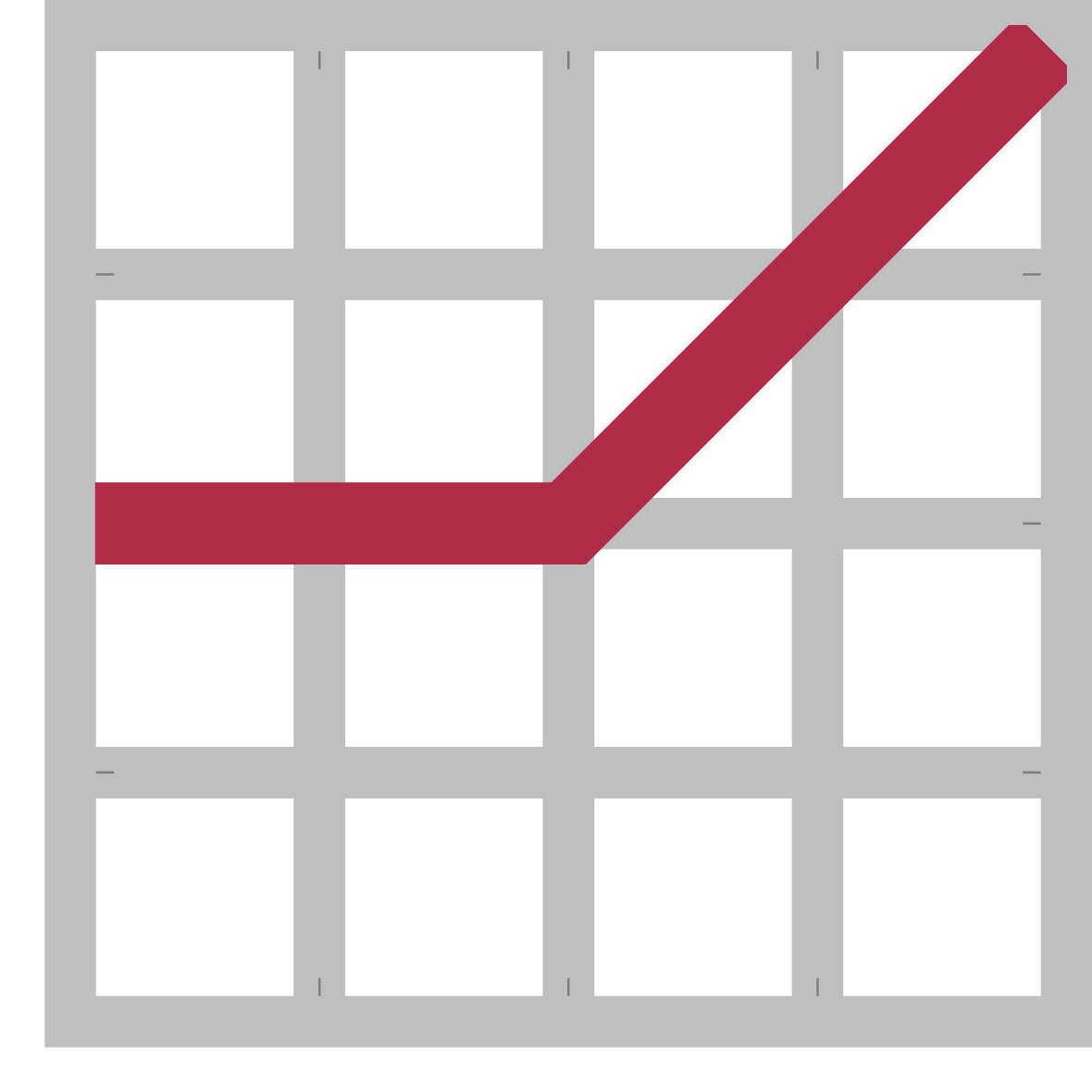 |
Call Option | A long call option with strike X on an asset A pays Max(0, A−X) at maturity. The payoff is convex and therefore a premium must be paid for it. |
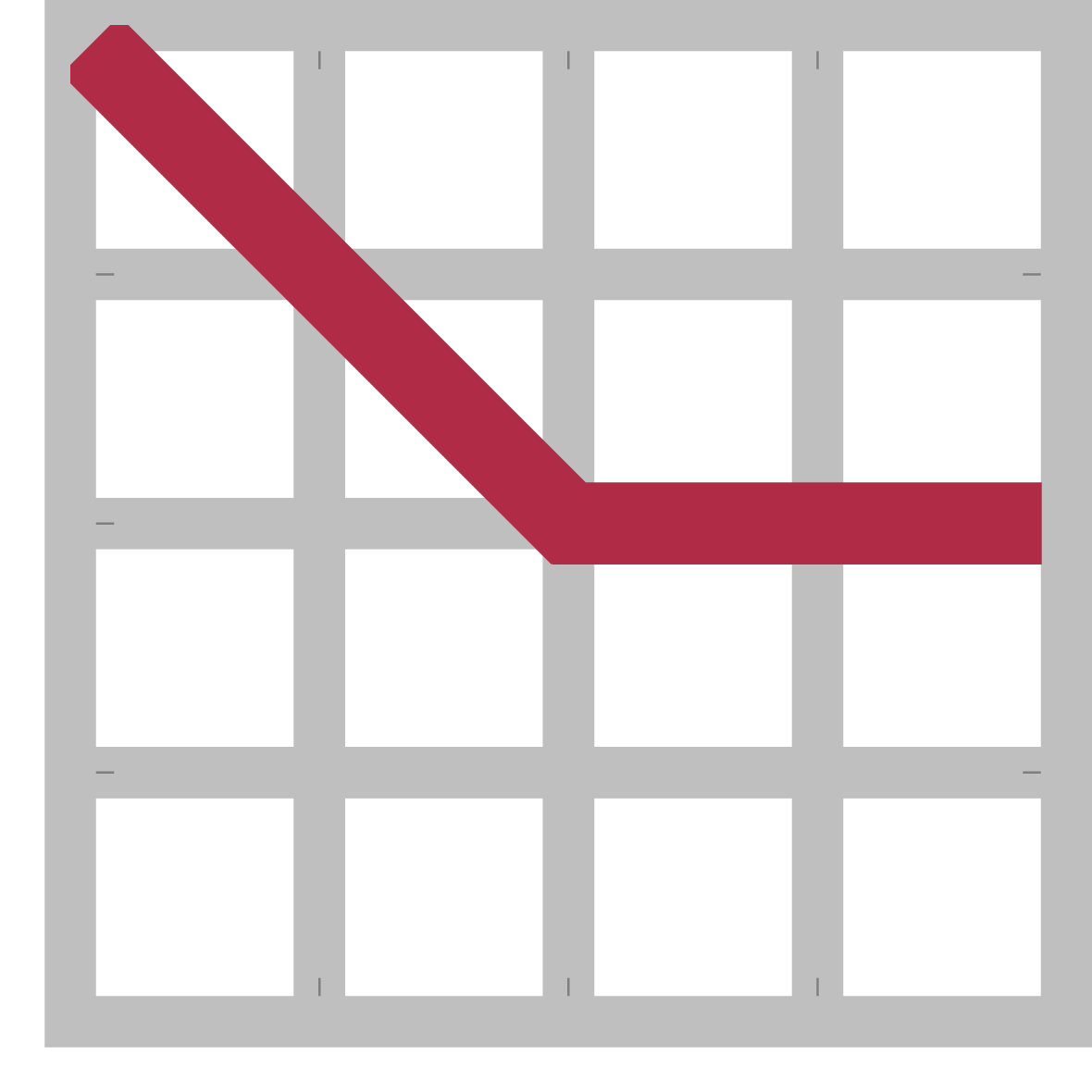 |
Put Option | A long put option with strike X on an asset A pays Max(0, X−A) at maturity. The payoff is convex and therefore a premium must be paid for it. |
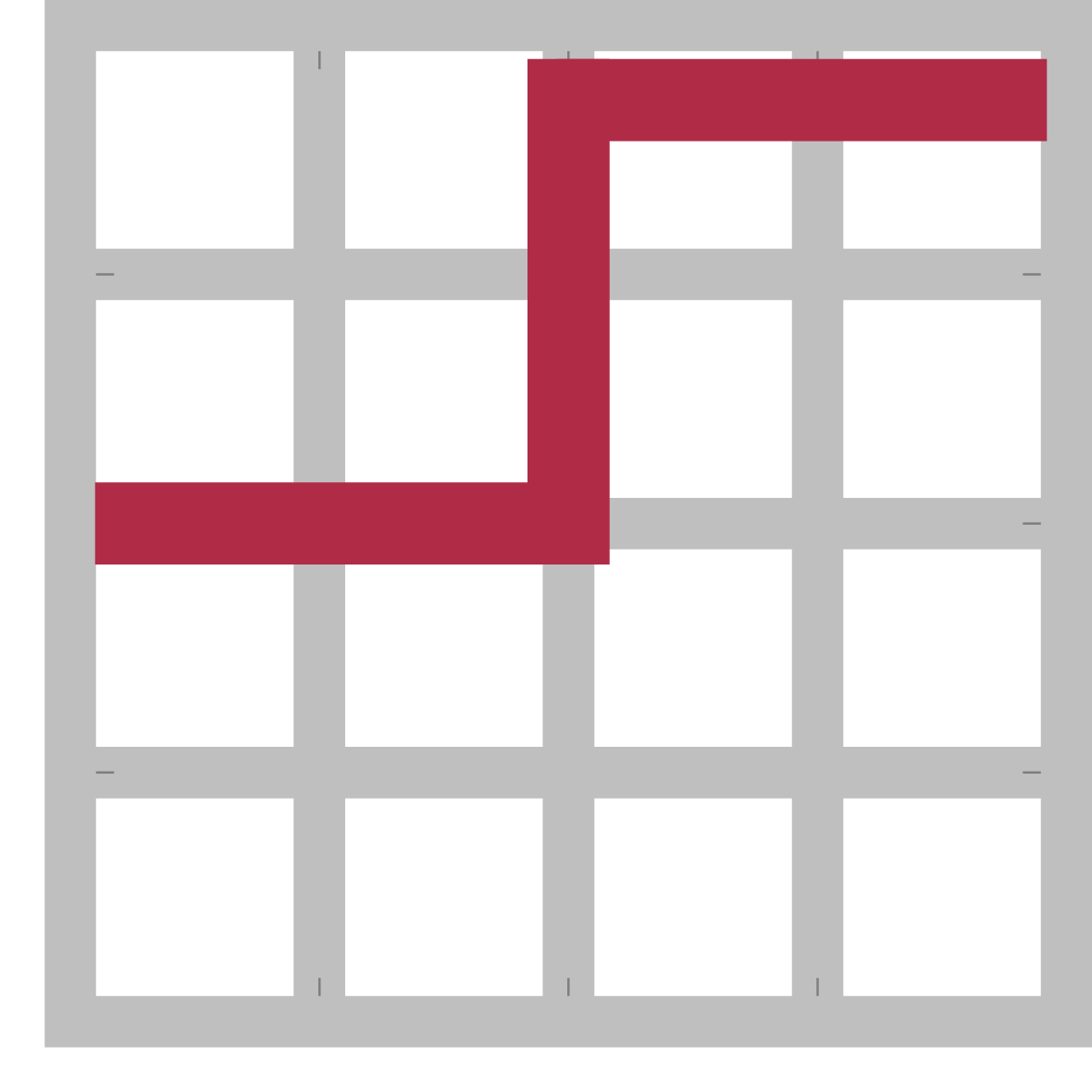 |
Digital Call | A digital call option with strike X pays X at maturity if the asset price is at or above the strike, otherwise zero. Simpler payoff than a standard call. |
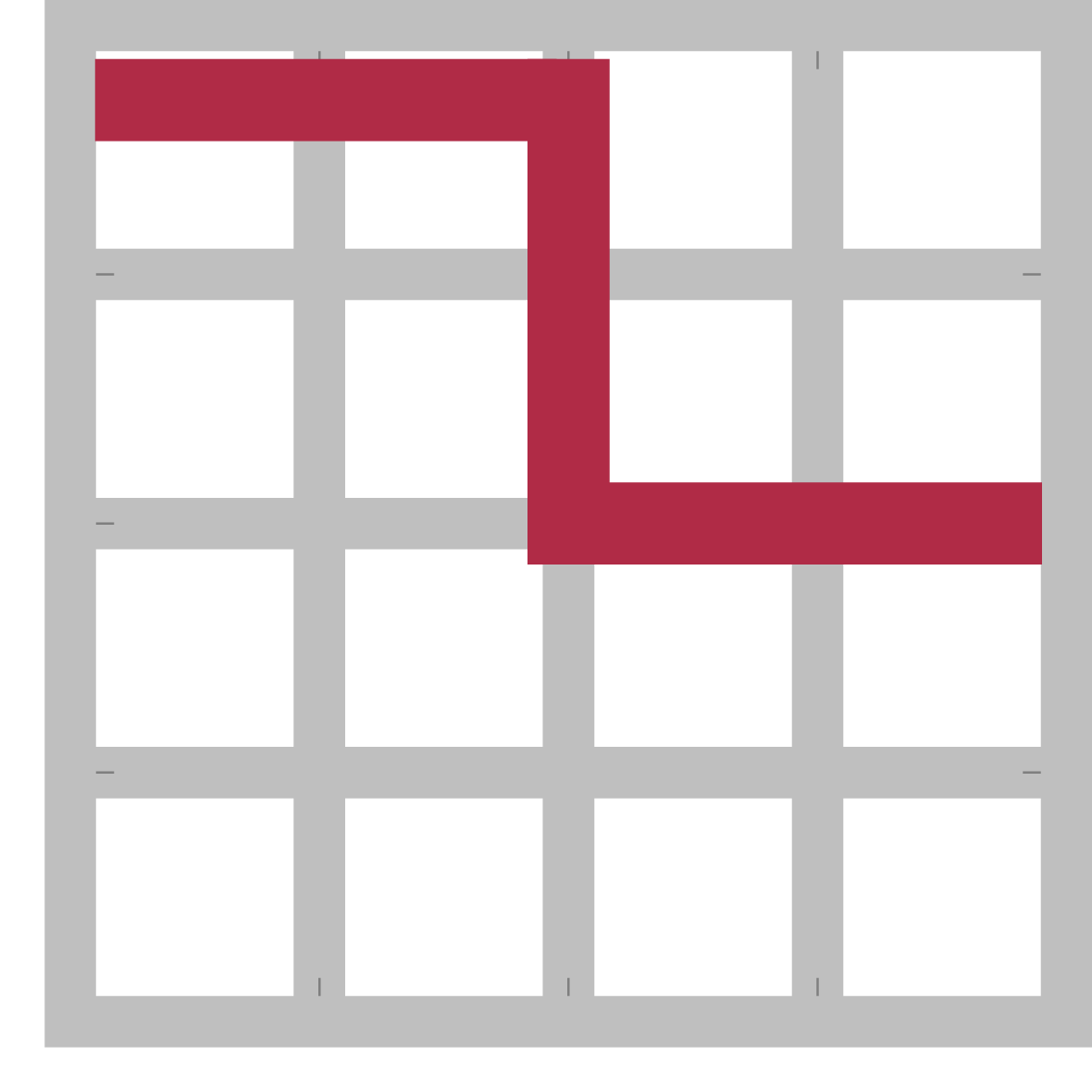 |
Digital Put | A digital put option with strike X pays X at maturity if the asset price is below the strike, otherwise zero. |
Barrier options are the most complex ingredients discussed in this chapter. Like standard options they come as calls or puts with a defined strike and maturity — but they also have a predefined barrier level which the underlying asset price must touch during the option's lifetime to trigger the barrier. There are two types:
Knock-in barrier · The option comes into existence only when the underlying asset price touches the barrier. If the barrier is never touched, the option cannot be exercised.
Knock-out barrier · The option ceases to exist when the underlying asset price touches the barrier.
The barrier can be triggered by an upward move (up-knock-in or up-knock-out) or a downward move (down-knock-in or down-knock-out). Some barrier options pay a rebate to the investor if the option knocked out or failed to knock in.
This creates a fundamental difference from standard options: the payoff of a barrier option at maturity depends not only on the asset price at maturity, but also on whether the asset price touched the barrier at any point during the option's lifetime.
| Icon | Ingredient | Description |
|---|---|---|
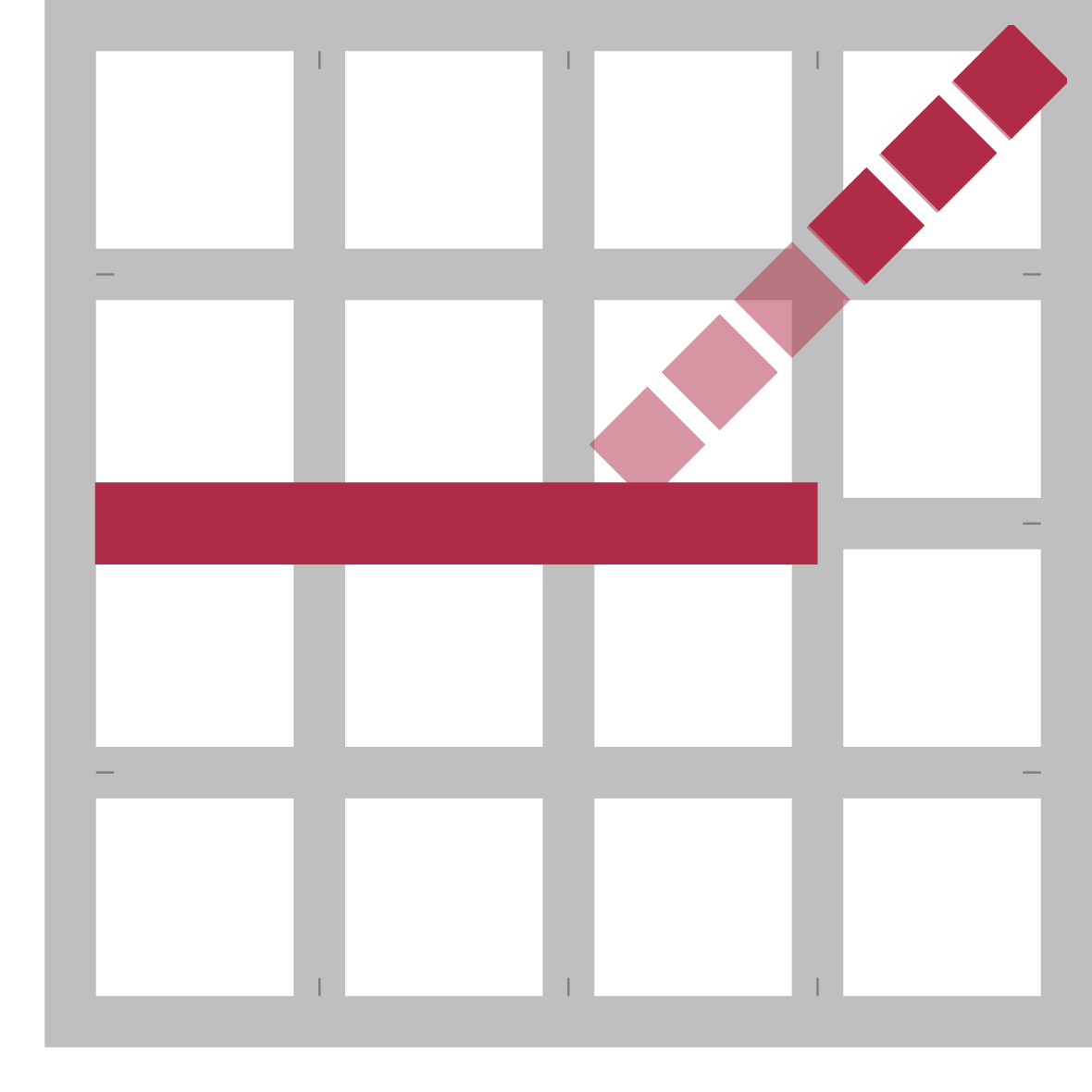 |
Up-knock-in Call | With strike X and barrier B, pays Max(0, A−X) at maturity if the barrier is touched during its lifetime — otherwise expires worthless. |
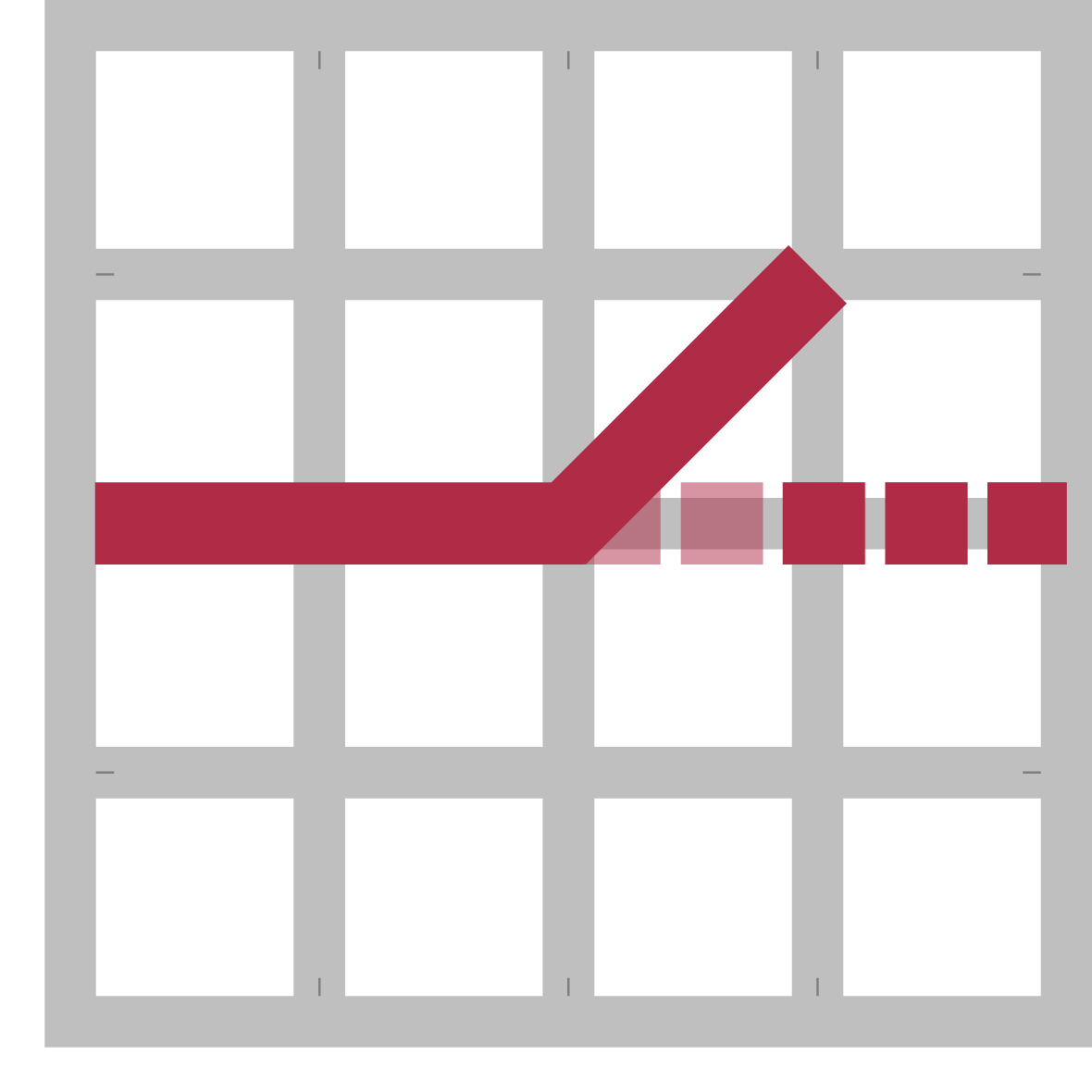 |
Up-knock-out Call | With strike X and barrier B, pays Max(0, A−X) at maturity if the barrier has not been touched — otherwise expires worthless. |
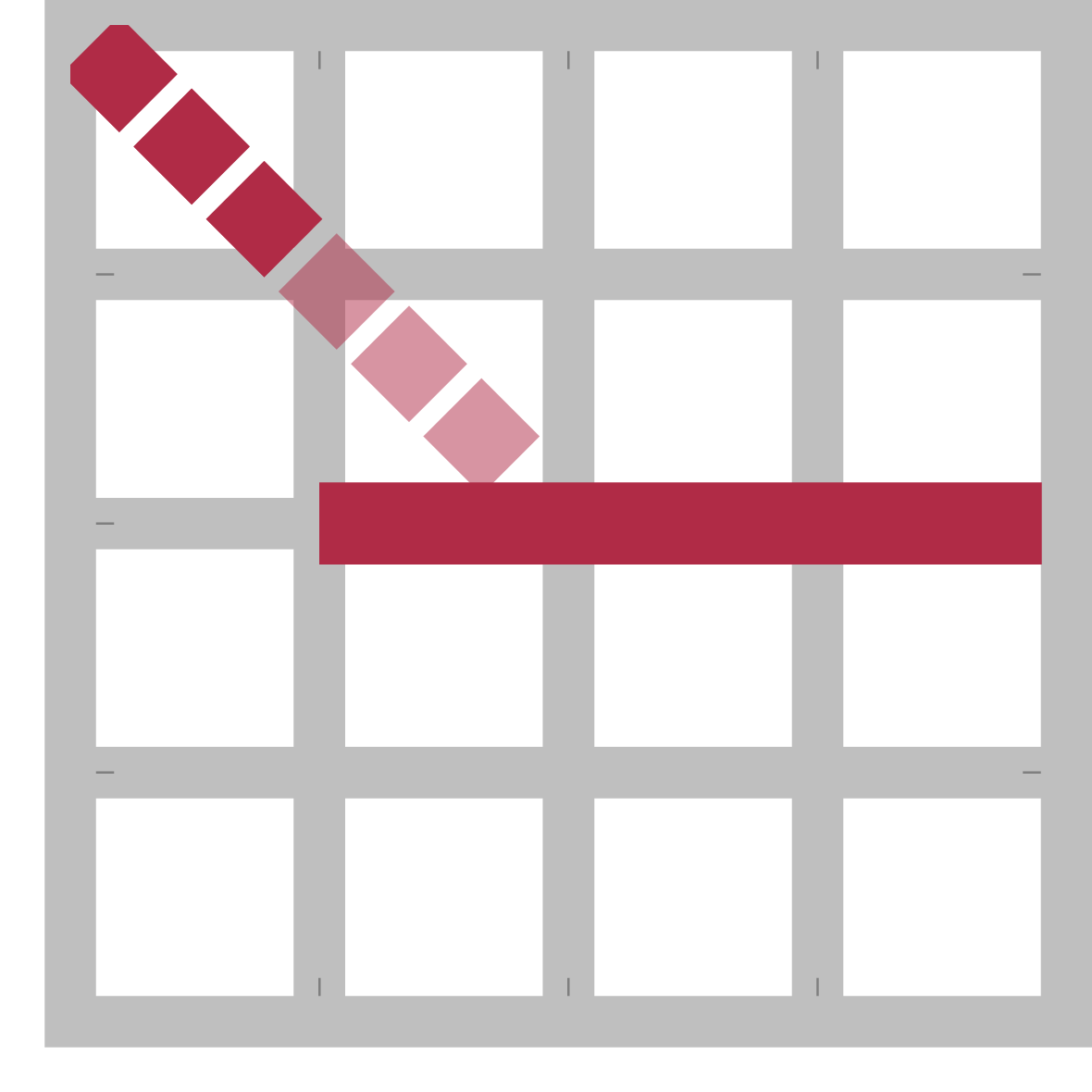 |
Down-knock-in Put | With strike X and barrier B, pays Max(0, X−A) at maturity if the barrier is touched during its lifetime — otherwise expires worthless. |
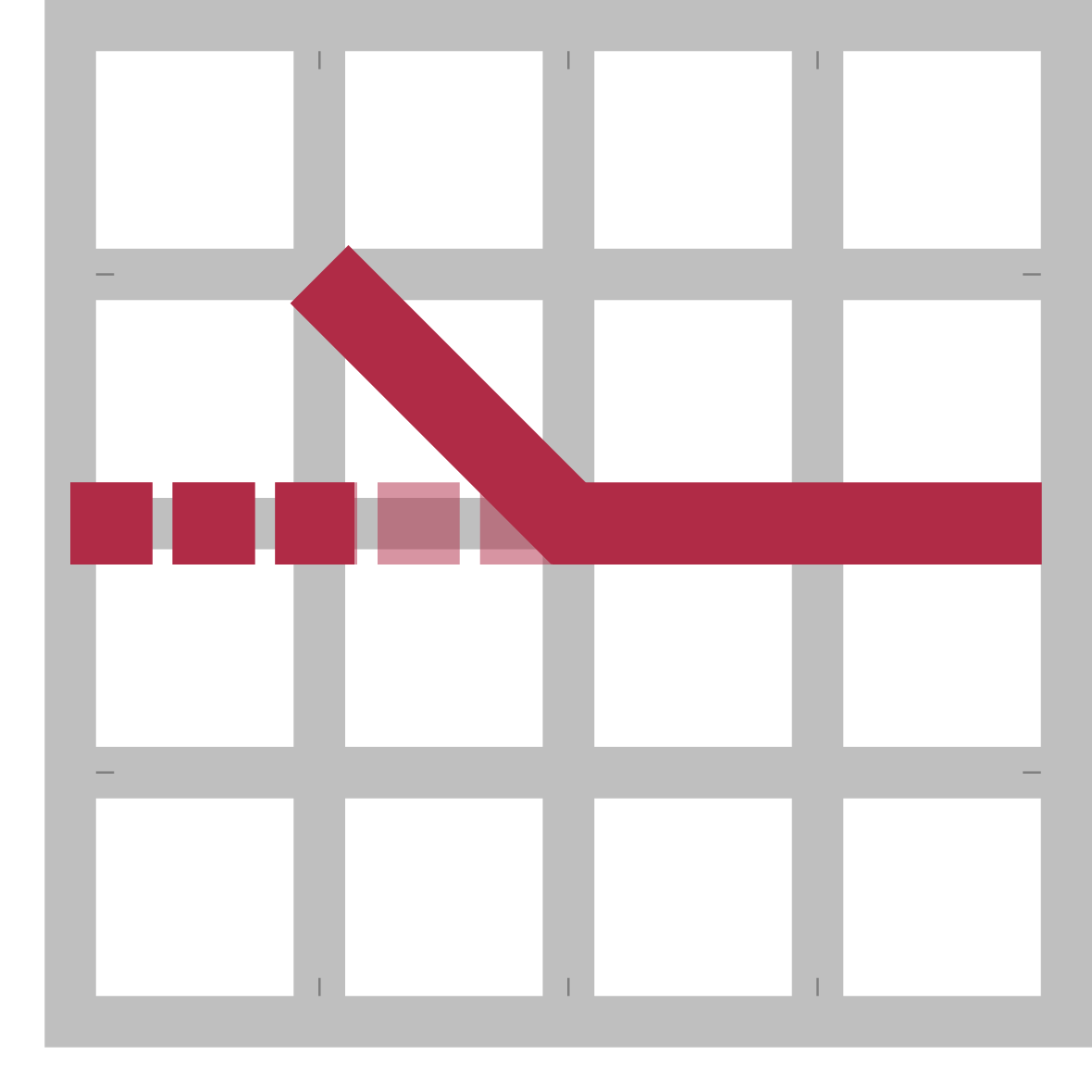 |
Down-knock-out Put | With strike X and barrier B, pays Max(0, X−A) at maturity if the barrier has not been touched — otherwise expires worthless. |
Barrier options are popular in structured products because they are typically cheaper than standard options — the less likely a knock-in barrier is to be touched, the cheaper the option. When a product contains a short option, barrier options can also reduce product risk, since the short option may never knock in or may knock out entirely.
Every structured product's payoff can be explained by its replicating portfolio — a weighted combination of assets, derivatives and fixed-income instruments that exactly replicates the product's payoff at maturity:
The replicating portfolio is created at issuance and defines the product's value throughout its lifetime. It can contain both long and short positions:
Long component · The investor buys the component from the product provider at issuance and receives the corresponding payoff at maturity.
Short component · The investor sells the component to the product provider at issuance and pays the component's payoff to the provider at maturity. A short option receives a premium at issuance; a short fixed-income position borrows capital and must repay principal and interest at maturity.
An important constraint is that the product value must remain positive throughout its lifetime. To ensure this, issuers may need to rebalance the portfolio during its lifetime, or implement an early redemption rule that terminates the product and returns any remaining positive value before it can turn negative.
Just as different bartenders may use slightly different recipes for the same cocktail, there is often more than one way to replicate a given structured product payoff. The most important equivalence relationship is call-put parity:
For a call and a put on the same underlying asset with the same strike and maturity, and a zero-bond paying the strike at maturity, these two portfolios have identical value:
Long CallLong Put Underlying
This allows financial engineers to substitute a put option with a call plus a zero-bond plus a short position in the underlying asset — and vice versa.
A second set of equivalence rules applies to barrier options: a knock-in option plus a knock-out option (same underlying, strike, barrier and maturity) equals a standard option:
For knock-in and knock-out options on the same underlying asset, with the same strike, barrier and no rebate:
Up-KI CallUp-KO CallCallDown-KI PutDown-KO PutPut- Underlying asset (equities, commodities, currencies) — defines what the product's payoff depends on
- Fixed-income instruments (money market, zero-bond, coupon bond) — moderate risk or enable leverage; priced by central bank policy rates
- Standard options (call, put, digital call, digital put) — add convexity, concavity or leverage to the payoff
- Barrier options (knock-in, knock-out) — fine-tune risk and cost; payoff depends on path of the underlying during the product's lifetime
- Defined and created at issuance; defines the product's value throughout its lifetime
- Can contain long and short positions in assets, options and fixed-income instruments
- Must remain positive throughout the lifetime — requiring rebalancing or early redemption rules if necessary
- Is not always unique — equivalence rules (call-put parity, knock-in/knock-out) allow the same payoff to be replicated in different ways
- May require handshake rules, where a bond's face value matches the strike level of option components
Technical Appendix — Barrier Options in Detail
Figure 7 shows the payoff of an up-knock-out call and an up-knock-in call with strike X and barrier B. For both options the payoff changes significantly once the barrier is touched: the up-knock-out call ceases to exist, while the up-knock-in call becomes a standard European call option the moment the barrier is triggered. Product issuers typically use dotted payoff lines to indicate payoffs after a barrier hit.
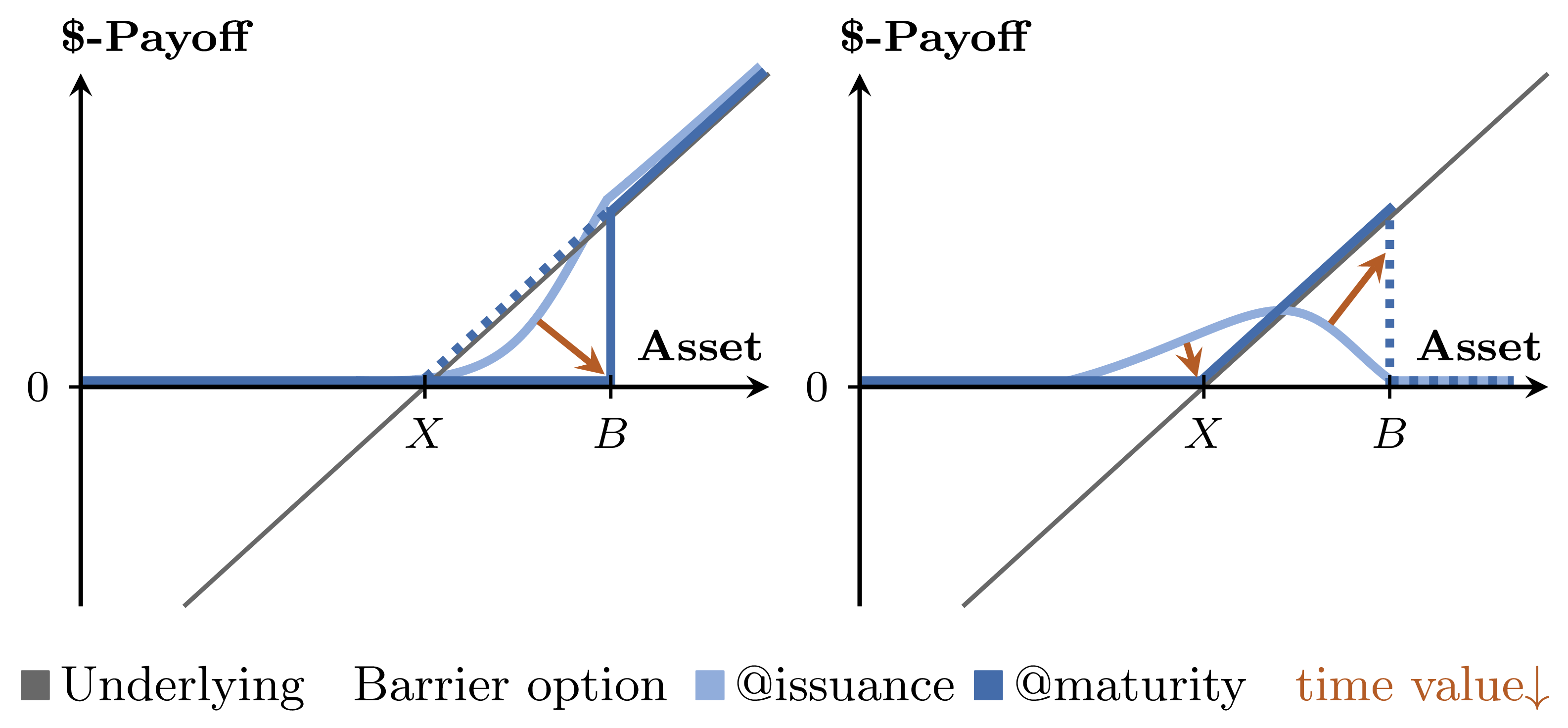
Payoff of an up-knock-in call (left) and an up-knock-out call (right). Dotted lines indicate payoffs after a barrier hit. Note that around the strike X, the up-knock-out call is convex (positive time value); just below the barrier B it is concave (negative time value) — shown by the direction of the arrows.
When assessing the risk profile of barrier options, the barrier hit probability is essential. It depends on three factors: the probability increases when the asset price moves closer to the barrier, with higher asset price volatility, and with longer time to maturity.
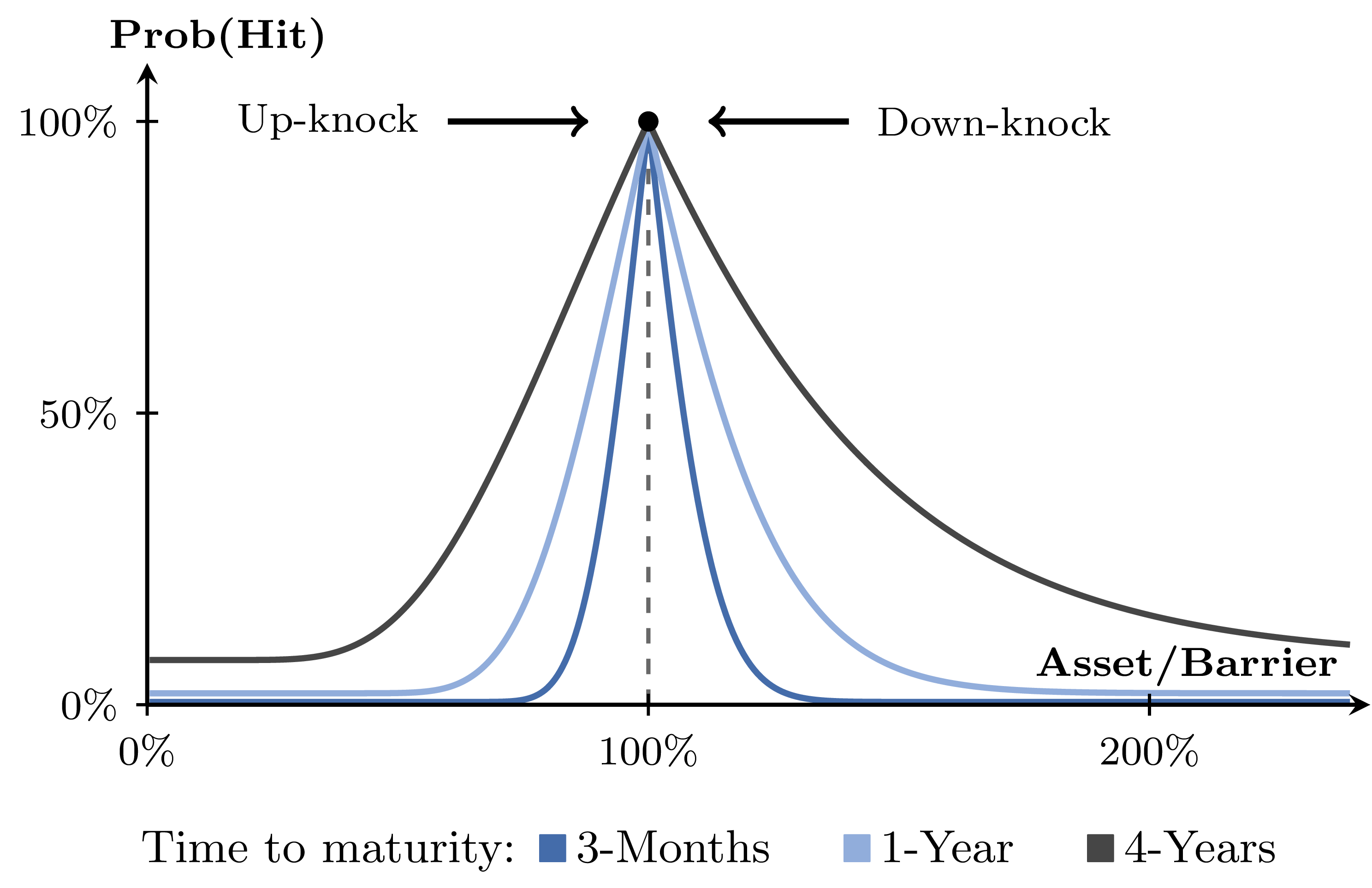
Barrier hit probability for up-knock options (left) and down-knock options (right) for different times to maturity. The probability increases as the asset price approaches the barrier and as time to maturity increases.
The barrier hit probability also influences the probability distribution of barrier options at maturity. While the distribution at issuance is smooth, at maturity it becomes semi-discrete — both the up-knock-in and up-knock-out calls have a discrete probability of expiring worthless (either because the asset is below the strike, or because the barrier condition was not met).
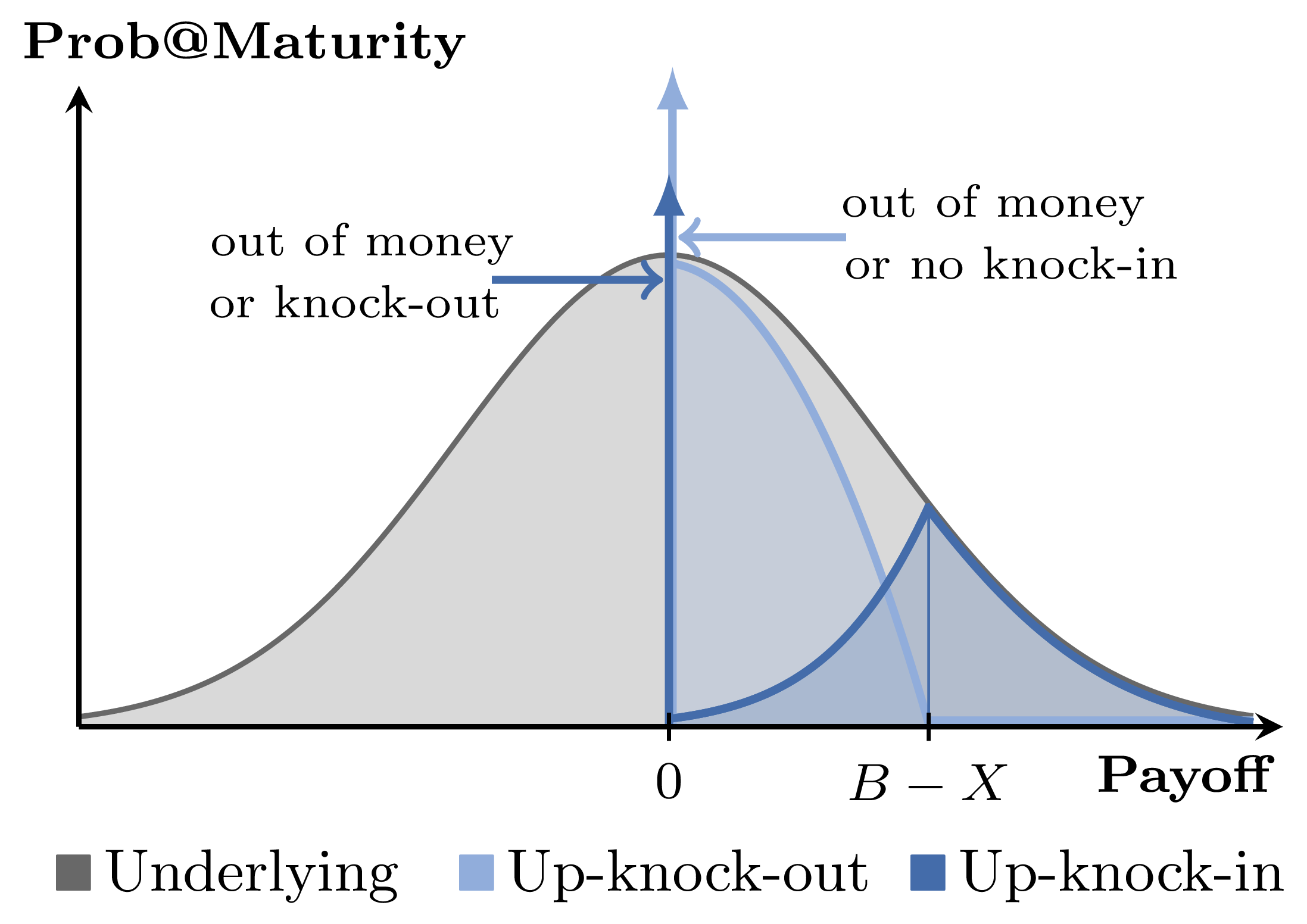
Probability distribution at maturity of an up-knock-in call and an up-knock-out call, with discrete probability spikes denoting the probability of a worthless expiry. At maturity, the up-knock-in call shows a local peak at the barrier, since once the price hits the barrier, large moves away from it are less likely than small ones.
For educational purposes only. Not investment advice. Derivative products carry significant risks and may not be suitable for all investors.