
"There are few professions whose primary objective is to advance the cause of humanity rather than simply to make money or accrue power. Among this limited group of humanitarians I would number teachers, nurses, bookstore owners, and bartenders."
Jack McDevitt
American science fiction author
Shaken, Not Stirred
A Guide to Derivative Index Strategies
Derivative index strategies — also known as structured products in the retail investment industry — allow investors to tailor their exposure to financial market indexes in ways a direct investment cannot. What do they have in common with cocktail menus? More than you might think.
It is not enough to know the different flavours one can achieve with cocktails — a great bartender needs to master the different cocktail recipes to achieve these flavours with aplomb. The same holds for structured products: just as we can explain the four payoff "flavours" — leverage, short, convexity, concavity — as theoretical concepts, we also need to understand how these payoff concepts are accomplished through the four main categories of structured products.
It turns out that the world of structured products is remarkably similar to the world of bar cocktails. While there are many cocktail recipes, most of them can be described as modifications of one of five traditional basic bar cocktails — ancestrals, sours, highballs, spirit-forwards and complex sours. Similarly, structured products can be categorised into four main product categories: capital protection, yield enhancement, participation and leverage. These four categories achieve the four payoff flavours — convexity, concavity, long/short and leverage.
Just as a bartender organises his drinks, mixers and garnish so that he can efficiently make drinks, systematically categorising structured products into main product categories helps investors find their way through a wide range of products. The structured product categories are the equivalent of a cocktail menu — and the Swiss Derivative Map, maintained by the Swiss Structured Products Association (SSPA), is one of the most comprehensive such menus available. The four product categories used throughout the IndexesIQ Derivative Academy align with the SSPA's standard classification, which is also adopted by EUSIPA — the European Structured Investment Products Association — and the BSW in Germany, making it the de facto European industry standard.





Before investing in any derivative strategy, it is essential to understand how it works — its payoff in different market scenarios, the risks it carries, and whether it suits your investment objectives. The IndexesIQ app allows you to analyse the payoff and probability distribution of profits and losses for each strategy type, and to run backtests comparing the historical performance of different strategies on the same underlying index.

Capital Protection
Capital protection products use options to provide downside protection on the underlying index. The payoff is convex — losses are limited at a defined protection level, while the investor retains participation in upside moves, sometimes subject to a cap.
Typical products: Capital-protected certificate, principal-protected note

Yield Enhancement
Yield enhancement products enhance returns by selling options and collecting the premium as additional income. As concave products, they suit investors willing to cap their upside in exchange for extra yield. The sold option introduces a probability spike at the cap level.
Typical products: Discount certificate, reverse convertible, worst-of reverse convertible

Participation
Participation products allow the investor to take a long or short position in the underlying index through tracker certificates. More complex variants add non-linear elements — the bonus certificate offers protection above a barrier; the twin-win profits from moves in either direction.
Typical products: Tracker certificate (long & short), bonus certificate, twin-win certificate

Leverage
Leverage products amplify the return of the underlying index. Simple versions include call and put warrants and mini-futures. More complex products such as constant leverage certificates or spread warrants offer defined or variable leverage ratios.
Typical products: Call & put warrants, mini-future, constant leverage certificate, spread warrant
Each product category produces a characteristic payoff shape at maturity and a corresponding probability distribution of returns. Understanding these shapes is essential to comparing products — two products with similar expected returns can have very different risk profiles.
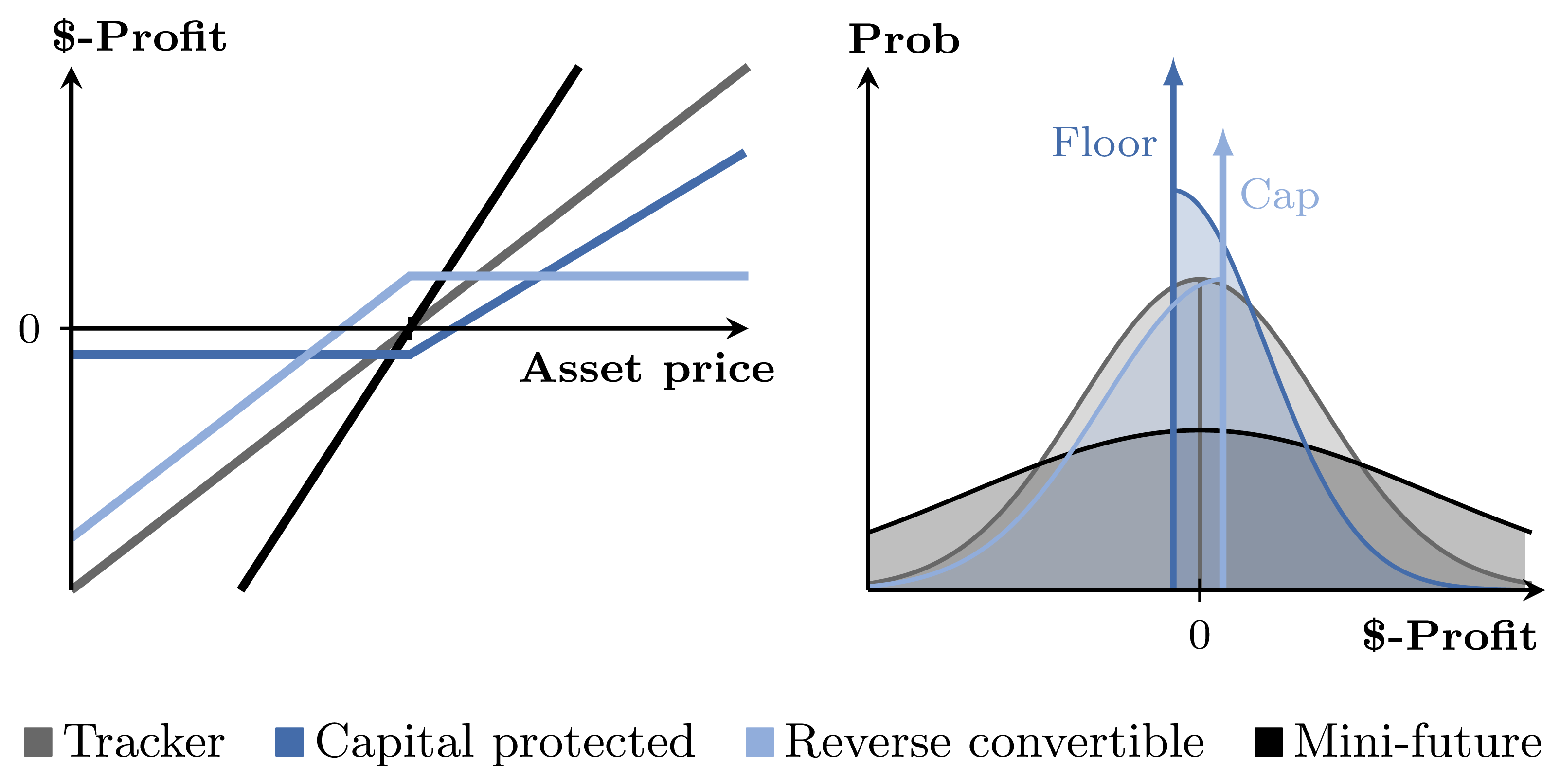
Left: Stylised payoffs of the four product categories at maturity. Right: The corresponding probability distribution of profits. The convex capital protection product produces a right-skewed distribution with a probability spike at the protection level; the concave reverse convertible produces a left-skewed distribution with a spike at the cap; the linear tracker mirrors the underlying asset's distribution; and the leverage product produces a proportionally stretched distribution.
Many product providers illustrate the four categories in increasing order of financial risk. In general, leverage products carry the highest risk and return potential, while capital protection products carry the lowest. However, within each category there is a wide range of products with varying risk levels. The SSPA Swiss Derivative Map provides a detailed product-level classification within each category.
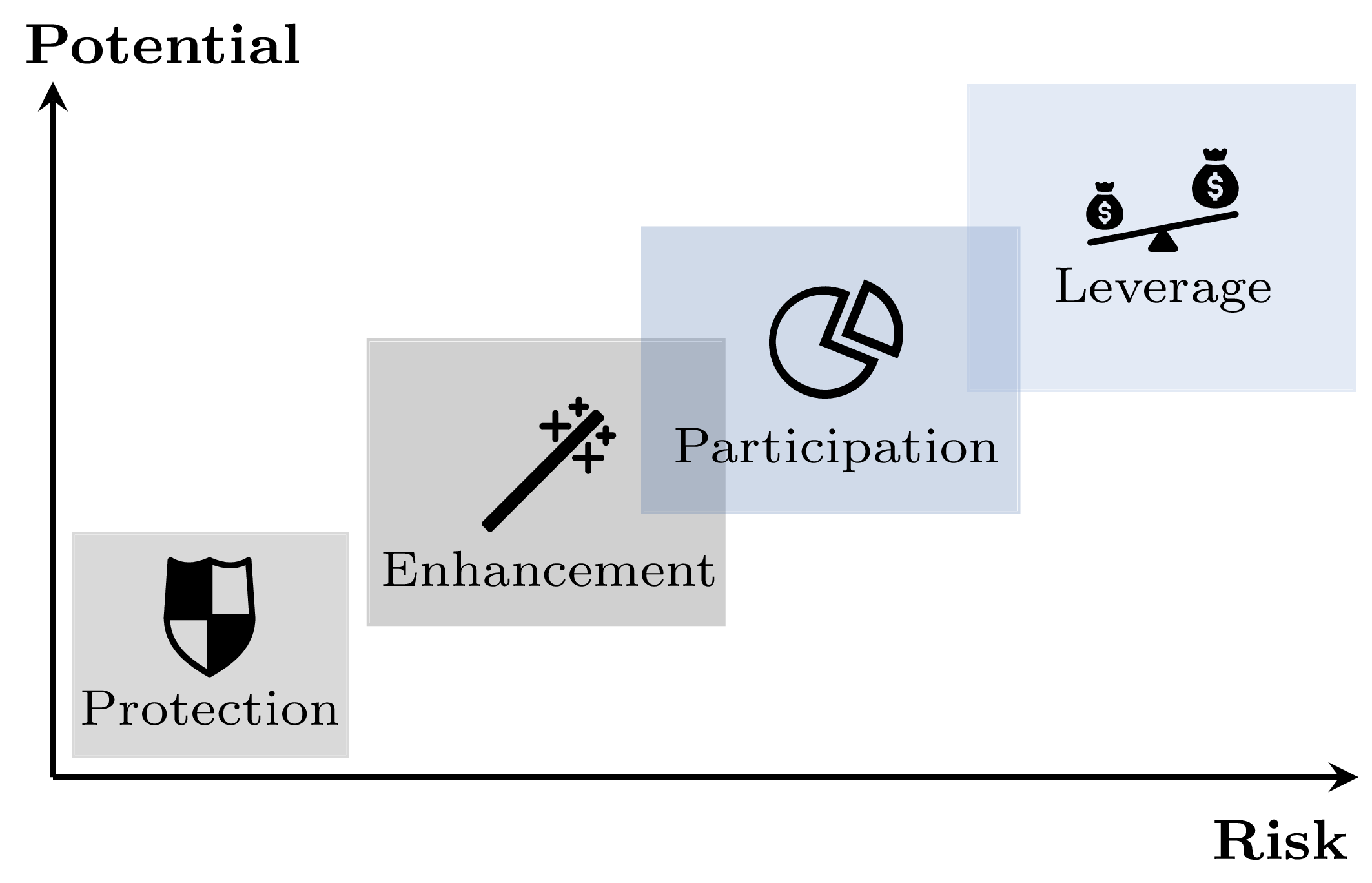
Risk and return potential of the main structured product categories, shown in stylised form. The categories overlap in terms of actual risk profile — a relatively risky yield enhancement product (e.g. a worst-of reverse convertible) may expose investors to more downside than a relatively conservative participation product.
| Category | Payoff shape | Key risk | Suited to |
|---|---|---|---|
| Capital Protection | Convex — losses floored, upside capped or partial | Opportunity cost if markets rally strongly; issuer credit risk | Risk-averse investors seeking index exposure with downside floor |
| Yield Enhancement | Concave — capped upside, full or partial downside | Full downside exposure in sharp market falls; worst-of versions multiply risk | Investors willing to cap gains in exchange for enhanced income in sideways markets |
| Participation | Linear — mirrors underlying, with possible barrier features | Barrier breach eliminates protection; short trackers carry unlimited upside risk | Investors wanting pure or modified index exposure with optional structural features |
| Leverage | Amplified — gains and losses multiplied | Amplified losses; knock-out risk; total loss possible | Investors with high risk tolerance seeking magnified short-term index exposure |
- Capital protection — incorporates a convex payoff by buying options. Typical example: the capital-protected certificate.
- Yield enhancement — uses a concave payoff for investors who want to enhance bond returns by selling options. Typical example: the reverse convertible.
- Participation — utilises a long or short position in the underlying asset, with optional non-linear features. Typical example: the tracker certificate.
- Leverage — offers an amplified payoff for investors seeking magnified returns with high risk appetite. Typical example: the mini-future.
This classification aligns with the SSPA Swiss Derivative Map and the EUSIPA European map — the standard used across Switzerland, Germany, Austria and the UK. Keep in mind that within each category you will find products with different levels of financial risk and different levels of payoff complexity.
For educational purposes only. Not investment advice. Derivative products carry significant risks and may not be suitable for all investors.