
"Too much of anything is bad, but too much champagne is just right."
F. Scott Fitzgerald
American novelist, The Great Gatsby
How to Assess Risk and Return
Performance measures, probability distributions, volatility and value-at-risk for derivative index strategies.
To become a master bartender in a top-rated bar, it does not suffice to merely learn how to mix some standard cocktail recipes. You need to learn the chemistry involved in creating cocktails — the level of alcohol in each ingredient, which flavours pair well together and which don't. One bartender once told me that champagne is an exception in cocktail mixing: adding it to your favourite cocktails practically never hurts. Perhaps he was inspired by reading F. Scott Fitzgerald.
Likewise, one needs to understand the "chemistry" of structured products in order to become an expert. As a first step, we need to familiarise ourselves with the most common performance and risk measures that characterise structured products. We will use standard European call and put options as examples to illustrate the different measures. The corresponding equations are provided in the appendix at the bottom of this page.
A European option can only be exercised at maturity. A European call pays the asset price minus the strike if positive at maturity, otherwise it expires worthless. A European put pays the strike minus the asset price if positive at maturity, otherwise it expires worthless. The BIS and ESMA publish reference material on options and derivatives terminology used across European markets.
Out of the money · An option is called "out of the money" if the asset price is below the strike (call) or above the strike (put).
In the money · An option is called "in the money" if the asset price is above the strike (call) or below the strike (put).
At the money · An option is called "at the money" if the asset price is at or very close to the strike.
There are three standard ways to measure the performance of options and structured products:
$-Payoff · The payoff shows the product's currency value as a function of the underlying asset price at maturity.
$-Profit · The profit (or loss) of the product — the payoff minus the price the investor paid at issuance.
%-Return · The return on investment (RoI) — the product's profit divided by the initial investment, quoted in %.
Throughout this Academy we use the prefix "$-" to indicate currency values and "%-" for percentage values.
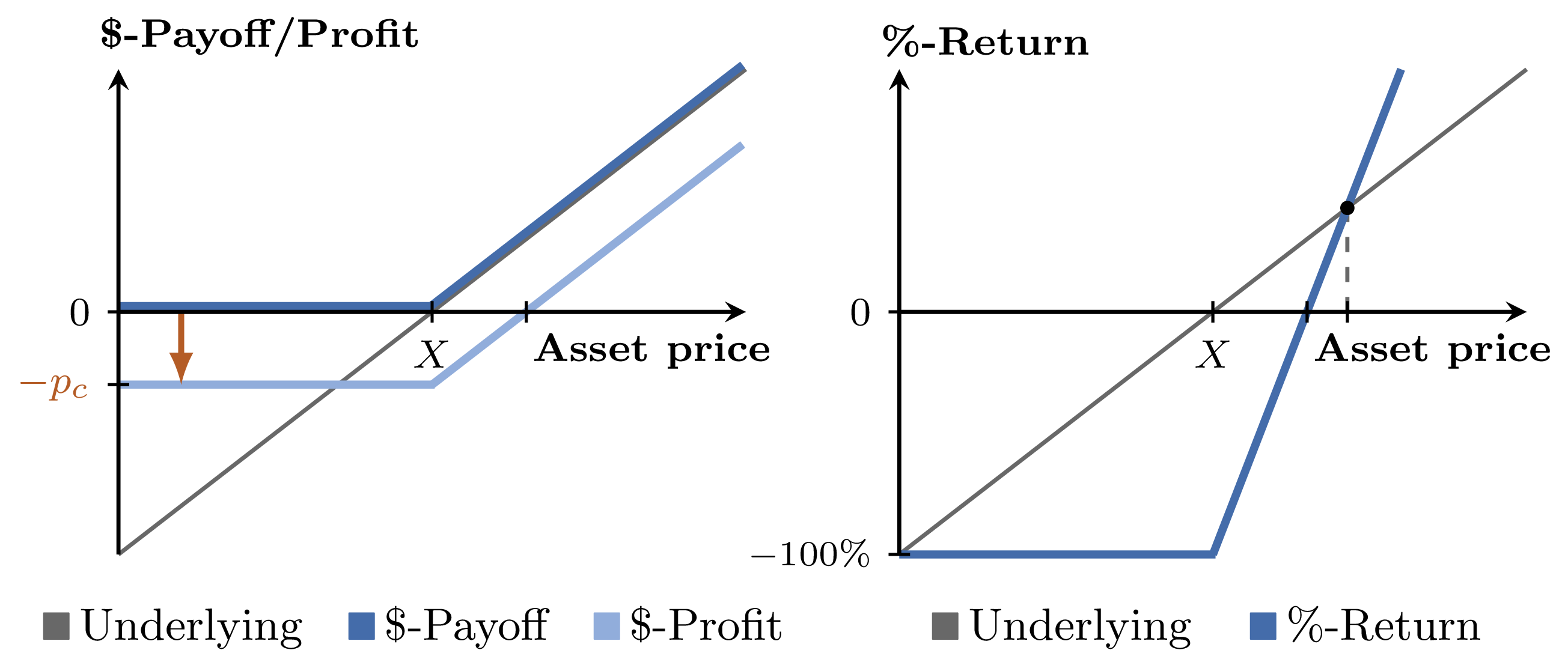
The Payoff denotes the value of the call with strike X at maturity. The Profit shows the difference between the Payoff and the initial option price. The Return (%) is the Profit over the initial option price. Above the strike, both Payoff and Profit move in sync with the underlying asset in absolute terms. However, in relative terms (%-Return), the call shows leveraged behaviour — a 1% move in the underlying produces more than a 1% move in the call value, because the invested premium is lower than the share price.
The most commonly used risk measure is price volatility:
Volatility · The volatility of a structured product measures the average amplitude of the product's price fluctuations around the current price. It is calculated as the standard deviation of daily $-Profits or %-Returns around the median.
While volatility is a good indicator of average risk, it is not sufficient for assessing the likelihood of large losses in a market crash. For that we need the full probability distribution:
Probability distribution · The probability distribution for returns indicates the likelihood of profits or losses, typically estimated using historical return data. It can be plotted for $-Profits (absolute performance) or %-Returns (relative performance).
From the probability distribution we can derive the value-at-risk:
Value-at-risk (VaR) · The value-at-risk reports the maximal expected loss from holding an asset over a given holding period and for a given statistical confidence level — typically 90%, 95% or 99%. For instance, the daily 90% VaR denotes the minimum loss an investor should expect to suffer 10 out of 100 trading days. VaR numbers typically increase with the length of the holding period and the confidence level. VaR is one of the key risk metrics required under the EU's PRIIPS regulation for structured product key information documents (KIDs).
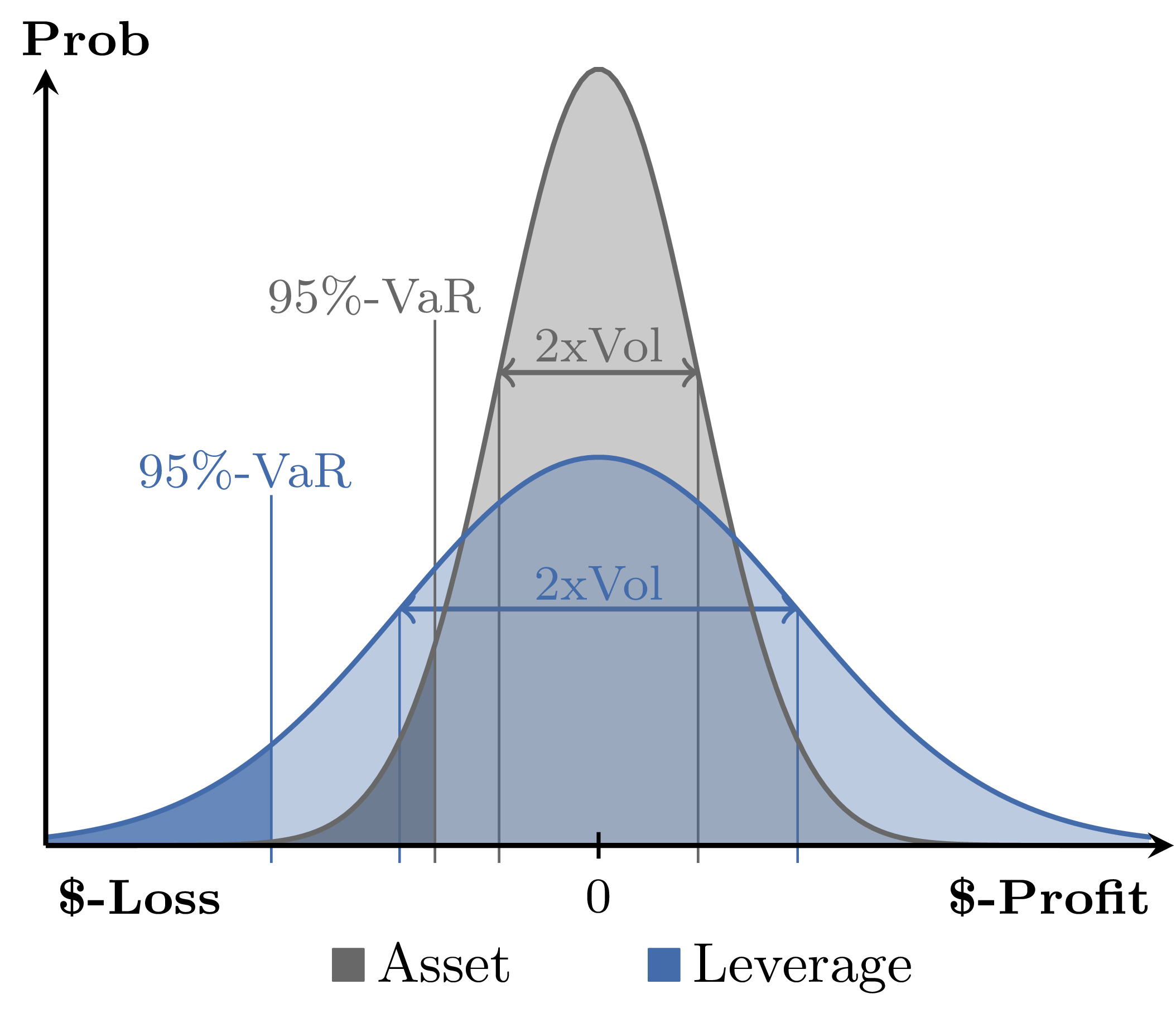
Probability distribution of profits, volatility (Vol) and 95% value-at-risk (VaR) for an asset and a leveraged investment on the asset. Volatility measures average price fluctuations — the "waistline" of the probability distribution. Value-at-risk measures extreme losses in bearish scenarios (dark shaded areas). The chart shows clearly how leverage increases both volatility and VaR compared to the underlying asset.
Two further risk measures describe how sensitively a product reacts to changes in the underlying asset price:
Participation · The participation of a product indicates its absolute price sensitivity with respect to changes in the asset price:
Leverage · The leverage of a product indicates the percentage change of the product's value per percentage change in the price of the underlying asset:
Since option prices are usually lower than the price of their underlying asset, options typically have a leverage greater than one. For example, if the underlying has a return of 1% and the product's return is 2.5%, the product's leverage is 2.5. Highly leveraged products offer higher upside potential but also higher risk of severe losses.
- $-Payoff = product value at maturity
- $-Profit = payoff minus initial investment
- %-Return = $-Profit over initial investment
- Option premia paid (convex) or received (concave) are only visible in $-Profit and %-Return charts
- The degree of leverage is only seen in %-Return charts
- Volatility — the probability distribution's waistline; measures average price fluctuations
- Value-at-risk — measures the likelihood of tail risk in extreme market scenarios; required in PRIIPS KIDs
- Participation — the product's $-price sensitivity to moves in the underlying
- Leverage — the product's %-price sensitivity; typically greater than one for options
Appendix — Call Option Formulas
For a call option with underlying price $A$, strike $X$ and initial premium $p_c$, the values at maturity are:
For educational purposes only. Not investment advice. Derivative products carry significant risks and may not be suitable for all investors.